A measured look at which smartphone health tools are real, which are screening aids at best, and why the equity gap may matter more than the gadgetry.
the “your phone is a medical device now” claim, slowed down
You’ve probably read some version of the headline. Your phone can take an ECG, check your blood pressure, screen a mole, test your hearing. All true, sort of, and that “sort of” is the whole point of this piece. The claim that the device in your pocket has quietly become a clinic deserves more skepticism than it usually gets, not because the tech is fake, but because the gap between “FDA-cleared screening tool” and “thing your doctor will treat you on” is wider than the marketing lets on.
So let me go capability by capability, roughly in order of how settled each one is. Some of these are genuinely mature and I’d happily recommend them to a relative. Others are research that got a press release. And the most interesting question, the one I keep circling back to, isn’t whether any of it works. It’s who it works for.
heart rhythm: the one that actually grew up
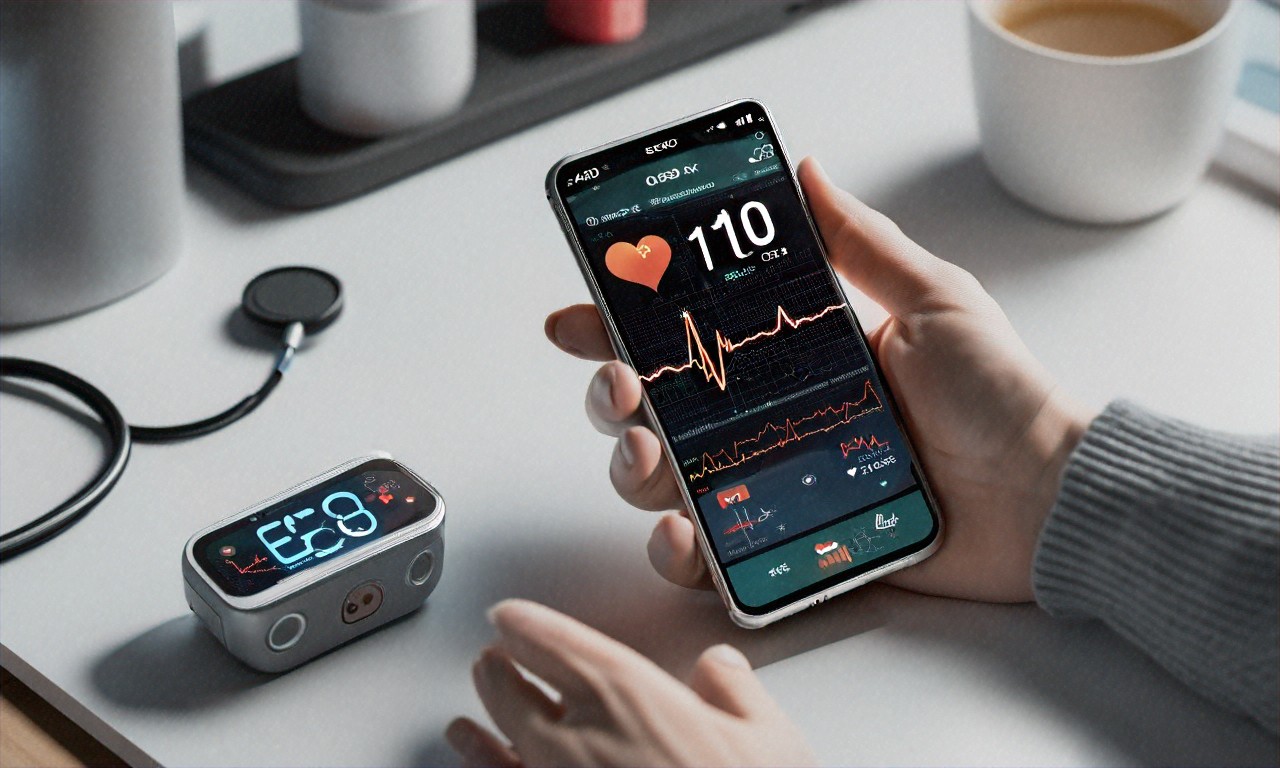
Start with electrocardiography. It’s the most established example by a comfortable margin. AliveCor’s KardiaMobile has been around for over a decade, a small piece of hardware you rest your fingers on that pairs with a phone app, and its FDA-cleared algorithm can flag atrial fibrillation along with a handful of other arrhythmias. Validation studies have reported high sensitivity for AFib detection, which is exactly the property you want most in a screening device. Apple Watch has carried FDA-cleared ECG since the Series 4, and Apple later layered on irregular-rhythm and AFib-history features. Galaxy Watch does something comparable, with regulatory clearance for ECG in several markets. So this isn’t one vendor’s gimmick. Heart rhythm is the settled corner of the whole field.
Here’s the genuinely useful part, and it’s a clinical workflow thing, not a gadget thing. Intermittent arrhythmias are maddening to catch. The classic problem is a patient who feels palpitations on a Tuesday, books an appointment, and by the time they’re hooked to a monitor the rhythm has gone quiet. A device you can press to your fingers the moment something feels off changes the odds of capturing that fleeting episode. That’s a real shift in how you’d diagnose something intermittent, and I don’t think it’s overstated.
The honest caveat: a wrist reading isn’t a 12-lead. Signal quality from one contact point on a watch is noisier than what a dedicated multi-electrode device gives you, which is in turn noisier than a hospital cart. For screening, the watch is impressive. Push past that and it’s really a prompt to go get the real test, not a substitute for it.
blood pressure without the cuff (with an asterisk the size of the moon)
This is where I start pumping the brakes harder. Traditional blood pressure measurement squeezes an artery with an inflatable cuff. Accurate, sure. Also a nuisance, especially if you’re meant to check three times a day, every day, for years. So companies have chased cuffless monitoring for ages, and a few phone- and watch-based options have now reached market with regulatory clearance behind them.
Two broad approaches show up. One uses the phone or watch to read blood-flow changes optically, a technique called photoplethysmography, or PPG. The other reads pulse waves at the wrist. Both share a catch that doesn’t get said loudly enough: they generally need calibration against a real cuff, and they drift, so you’re meant to recalibrate periodically. Between calibrations the readings can track reasonably close to a cuff for trend-watching. As a way to see your pressure drifting over weeks, that’s arguably more honest than the single number you get in a clinic, where white-coat nerves push readings up for a big chunk of patients.
But trend-watching is the ceiling, at least for now. I wouldn’t change a medication off a cuffless reading, and a careful clinician wouldn’t either. Alarming number? Confirm it with a real cuff before anyone acts. A watch that quietly logs your pressure through the day, no effort required, is a genuinely nice thing to have, and the engineering behind making that work passively at the wrist is honestly impressive. It’s just not the same animal as a measurement you’d stake a treatment decision on, and conflating the two is how people get hurt.
respiratory monitoring
The pandemic years pushed a lot of attention onto lung health, and the tech world responded. Two strands are worth separating.
The first is cough-sound analysis. ResApp Health built technology that listens to a cough through a phone microphone and screens for respiratory conditions, and the company was later acquired by Pfizer. Its pitch for telehealth is obvious enough, an early triage step before you decide whether someone needs imaging. Whether it saves the system real money at scale is the kind of claim I’d want to see proven rather than assumed, so I’ll leave it as a plausible promise.
The second is spirometry, the lung-function test where you measure how much air you can force out and how fast. Traditionally that needs a dedicated device. Turns out a phone’s microphone can estimate forced expiratory measures from the sound of a hard exhalation, and validation work suggests smartphone spirometry broadly agrees with conventional equipment, close enough to be genuinely useful for tracking trends in asthma or COPD even if it won’t replace a proper machine. What it buys you is time resolution. A patient blowing into a phone twice a week gives a doctor something a quarterly office visit never could: a chance to spot a slide before it becomes an emergency. That’s the recurring theme across most of these tools, by the way. Value lives in frequency, not in matching the gold standard on any single reading.
skin: where the equity problem gets concrete
Dermatology was always going to move fast here, and the reason’s not subtle. Skin conditions are visual, and phone cameras have gotten very good. SkinVision is a real, CE-marked app that photographs moles and lesions and runs AI analysis to flag melanoma risk. Screening tools like this are deliberately tuned toward sensitivity over specificity, meaning they’d rather send you to a dermatologist over a harmless mole than miss a real melanoma. For a screening tool, that’s the correct bias. The cost is false alarms, some anxiety, the occasional unnecessary copay. With melanoma, where early detection genuinely is the difference between a minor excision and a serious fight, that’s a trade most people would take.
Now the part I think is the real story. On darker skin, these apps tend to do worse, because the data they learned from skews toward lighter skin. The same pattern shows up across medical AI, well beyond dermatology, and it’s the thing I keep wanting people to sit with. A screening tool that works well for some populations and poorly for others doesn’t just help unevenly. It can widen the very gaps it’s sold as closing. Some companies are taking data diversity in their training sets seriously. Others, from what I’ve seen, are not. And because the failure is quiet, a confident-looking result that’s simply less reliable for you, it’s easy to miss until it’s hurt someone.
hearing tests, the quietly important one
This one doesn’t get enough airtime, and it might be where the cheap-screening argument lands hardest. The World Health Organization puts the number of people with some degree of hearing loss in the billions, and a huge share have never had a formal test. Not once. Smartphone audiometry, the classic beeps-at-different-frequencies test delivered through a phone’s calibrated audio and a decent pair of headphones, is chipping away at that. With calibrated headphones in a reasonably quiet room, these apps can produce audiograms that line up well enough with clinical booth results for screening purposes. Apple also added a hearing-test feature to iOS using AirPods Pro as the audio source, with results flowing into the Health app.
Where this matters most is places audiologists barely reach. Work like the hearX platform in South Africa has screened large numbers of people in underserved communities, training community health workers to run tests in schools and clinics with a phone and calibrated headphones instead of a five-figure clinical audiometer and a soundproof booth. You don’t need the booth for a screen. Just a quiet-ish room and a phone. And here, unlike the skin-app case, the equity math actually points the right way, which is part of why I find it the most quietly encouraging item on this list. Sometimes just learning you have a problem is the hard part. The path to help from there is often straightforward.
glucose: the hard problem people keep promising to solve
Non-invasive blood glucose through a phone is the one everyone wants, and it’s worth being blunt about where it stands. Plenty of companies have claimed they’re close. Almost all of them, over the years, have failed to hit clinical-grade accuracy, and that track record should shape how you read the next confident announcement. The physics is brutal. Glucose sits at low concentrations, and a pile of confounders, skin thickness, hydration, temperature, melanin, all interfere with optical measurement. None of that is a reason it can never work. It’s a reason to treat “three to five years out” the way you’d treat that phrase from anyone who’s been saying it for a while.
What actually exists today is less glamorous and genuinely useful: continuous glucose monitors that pair with phone apps. A Dexcom sensor still sits under the skin, there’s no getting around the needle yet, but the phone replaces the old dedicated receiver and adds a software layer the standalone hardware never had. Real-time readings, trend arrows, predictive alerts, shareable reports for a doctor. It isn’t the needle-free dream. It’s a real step that helps real people right now, which I’d argue counts for more than another spectroscopy press release.
mental health: fascinating, and the most ethically tangled
Your phone knows a startling amount about your behavior. How much you move, how often you check it, the rhythm of your typing, when you sleep, who you message and for how long. Research has found that shifts in these patterns can track with depression and anxiety, and earlier work suggested typing dynamics on a phone might serve as a behavioral signal for mood and cognition. The next generation of tools aims to do this passively, no daily mood log, the phone just watching patterns and flagging anomalies. There’s an obvious upside: catching a downturn before the person fully feels it would be a meaningful head start on intervention.
And there’s a privacy problem I find genuinely hard to wave away. Who sees this data? Could an insurer get at it? An employer? Passive monitoring of your mental state is exactly the kind of capability that needs strong guardrails in place before it goes mainstream, not after. I think the potential for misuse here is large enough that I’d want the rules settled first, which is not how this stuff usually goes.
the regulators are running behind, and they know it
All of this slams into a rulebook that wasn’t built for software that updates itself. The FDA has been adapting with its Software as a Medical Device framework, which scales the clearance burden to a product’s risk: light touch for wellness apps, full clinical validation for higher-risk diagnostics. Trouble is, the boundary keeps moving. An app can launch as a wellness tracker and quietly become something diagnostic through an update, and honestly, the line between “scrutinize this heavily” and “leave it alone” is brutally hard to draw when the product won’t hold still.
Europe made a different bet. The Medical Device Regulation came into full force and raised the time and cost of getting CE marking under the new rules. More safety assurance, yes. Also a real cost: some smaller developers have pulled back from the European market, which means patients there can lose access to tools available elsewhere. I don’t think anyone’s found the right balance, and I’m not sure there is a clean one. Too strict and you wall off useful tech from people who’d benefit. Go too loose and people start leaning on shaky tools for serious calls. That tension doesn’t resolve. It just gets managed, better or worse.
what doctors actually worry about
Two concerns come up more than any others, and neither is “the tech doesn’t work.”
The first is data overload. Most clinicians already field screenshots of watch alerts at odd hours. Now imagine every patient streaming daily pressure readings, weekly ECGs, monthly spirometry. Nobody can personally review thousands of data points per patient per year, and pretending otherwise is how you get burnout and missed signals in one go. A likely fix is software that aggregates patient-generated data and only pings a human when something genuinely looks off. Companies are building exactly that, though it isn’t widely deployed yet, so right now the flood is mostly arriving without a filter.
The second is liability, and it’s thornier. Say someone screens with an app, gets a clear result, skips further evaluation, and it turns out they had the condition after all. Who’s responsible? Maybe the app maker, maybe the phone maker, maybe the doctor who suggested the app? Nobody’s settled those questions, and until they are, plenty of clinicians will stay cautious about endorsing phone-based diagnostics even when the underlying tech is solid. Hard to blame them.
There’s also a quieter generational split in how the data gets used. Some doctors treat patient-generated readings as one more input alongside labs and exams. Others worry it breeds false confidence, in the patient (“my app says I’m fine”) or in themselves (“the algorithm cleared them, so I won’t dig further”). Both failure modes are real, and the fix is better training on how to fold these tools into judgment rather than lean on them. That’s slow, and the tech isn’t waiting.
the equity dimension, which I think is the actual headline
Here’s the strongest case for all of this, and also where I’d push back on the easy optimism. A specialist visit can run hundreds of dollars, more once you count getting to a city that has the specialist. Compare that to a screening app, which reaches anyone with a phone, and smartphone ownership is high and climbing worldwide. Eric Topol, the cardiologist and digital-health author, has argued for years that we’re still using a stethoscope designed two centuries ago while carrying pocket computers that can analyze heart sounds, skin lesions, and a dozen other clinical signals. As a general point about the absurdity of the gap, I think he’s right. Cardiac screening that once meant a trip to a distant hospital can now, in principle, happen anywhere.
In principle. That phrase is doing a lot of work. Access isn’t just owning the hardware. Digital literacy matters, so does connectivity, language support, and trust in a phone telling you something about your body. And circle back to the skin-app problem: if the algorithms underperform on darker skin, or older bodies, or whoever was underrepresented in the training data, these tools can quietly reinforce the disparities they’re pitched as fixing. Some companies treat data diversity as a first-order problem. Others treat it as a footnote. It’s a mixed picture, and I suspect it’ll stay mixed for a while, because the incentive to fix a quiet failure is always weaker than the incentive to ship.
so what’s a reasonable thing to actually do
I’ll land somewhere short of the usual breathless ending. Several of these tools are worth using today, with clear eyes about what they are. A personal ECG device or an Apple Watch will do honest work for heart-rhythm screening. Validated hearing-test apps cost almost nothing and might nudge someone toward help they’d never otherwise seek. Skin-check apps too, if you understand they work better for some skin than others and treat a clear result as a maybe, not a no. None of these replace a doctor. They catch things between visits, and they lower the bar to a first look.
The honest framing, I think, is this. Your phone hasn’t replaced your doctor, and the tools that pretend otherwise are the ones to distrust. What it can do is widen the front door, watch for patterns you’d miss, and occasionally flag something worth a real appointment. Whether that front door opens evenly for everyone, or mostly for the people it was already easiest to help, is the part still being decided. That’s the question I’d keep my eye on, more than the next sensor.

(0) Comments