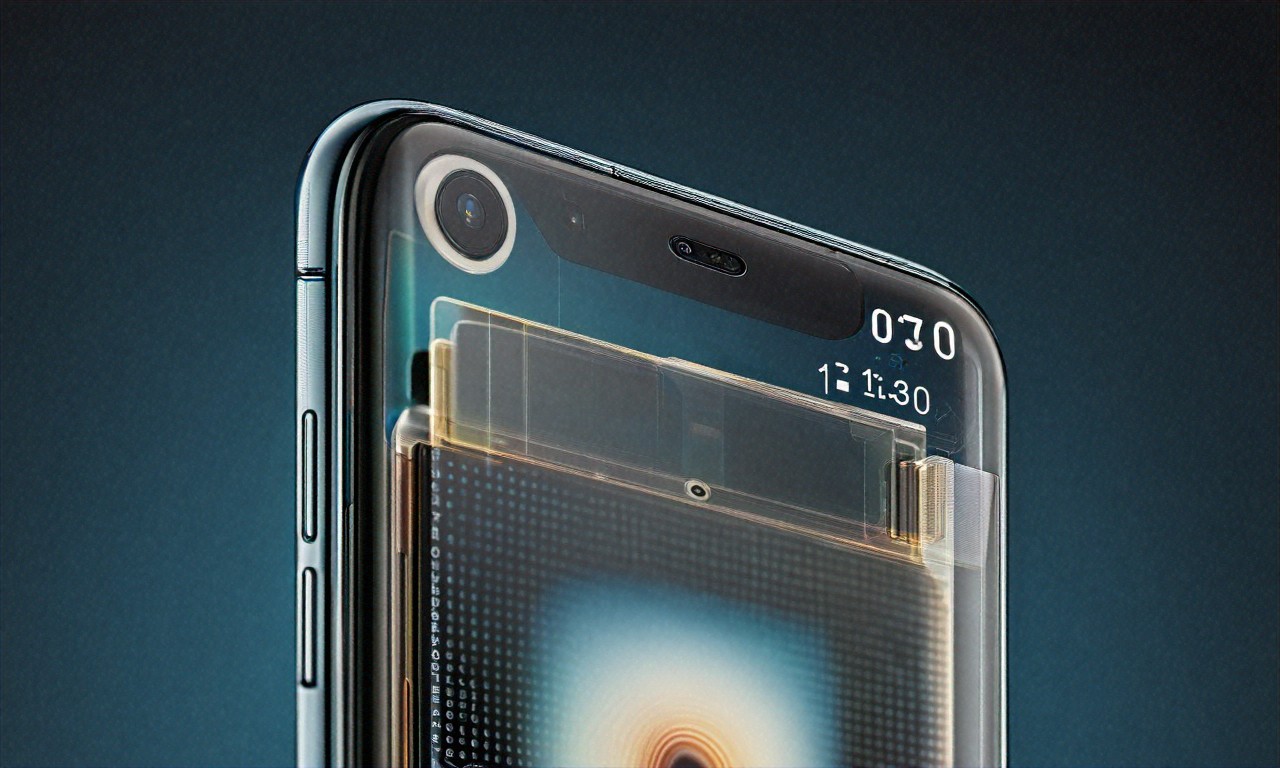
Understand the technology behind under-display cameras and how they’re finally delivering a truly bezel-less phone experience.
Wait, There’s a Camera Under There?
So I was tilting my Galaxy Z Fold 5 under a desk lamp the other day, squinting at the inner display, trying to find the camera. And I mostly couldn’t. With a white background and the right angle, there’s this faint texture difference in the upper-right area, a slightly off pixel pattern you’d probably never notice. But scrolling through apps? Watching a video? Gone. Completely invisible.
That still trips me out a little, honestly. There’s a whole camera sensor sitting behind those pixels, and your eyes just.. skip right over it. Four years ago, this was a gimmick that barely worked. Samsung’s first attempt on the Galaxy Z Fold 3 back in 2021? Rough. You could clearly see a lower-resolution patch on the screen, and the photos looked like you’d smeared Vaseline on the lens. But each generation has gotten measurably better, and now the tech is spreading beyond foldables into regular flagship phones from ZTE, Xiaomi, and Samsung.
Which got me wondering, how does any of this actually work? How do you make pixels that show you an image and let light through to a sensor at the same time? Turns out it’s one of the more interesting engineering puzzles in smartphones right now.
Pixels and Photons Don’t Get Along
Here’s the basic problem. A modern OLED screen packs millions of tiny organic light-emitting diodes onto a surface. Each pixel has red, green, and blue sub-pixels that glow on their own. Underneath all that sits a thin-film transistor (TFT) backplane controlling each pixel, plus cathode layers, encapsulation films, wiring: the works. All of it blocks incoming light. Stick a camera behind a normal OLED panel and it’d see about as much as you would staring through a brick wall. Nothing useful gets through.
So the engineering challenge comes down to a tug-of-war. You need the display section above the camera to be transparent enough for the sensor to grab usable light. But you also need that same section to display a picture. These two goals fight each other directly. More transparency means fewer circuit elements, less pixel density. Fewer pixels means you can see where the camera is. It’s a zero-sum situation, and solving it takes compromises and some pretty clever tricks.
The Transparency Budget
Engineers who work on this stuff talk about a “transparency budget,” which I think is a great way to frame it. A normal OLED panel lets through maybe 5-15% of incoming light; so 85-95% gets blocked. For a camera to produce anything usable, the panel above it needs roughly 25-40% transmittance. Jumping from 15% to 40% probably doesn’t sound dramatic, but it means rethinking how that entire patch of screen is built.
Every single layer in the display stack eats some light. The cathode alone can block around 40%. The TFT backplane swallows another 20-30%. If there’s a polarizer? That kills about 50%. Each layer has to be modified, thinned out, or swapped for something more transparent to hit the target. And every change you make affects either display quality, how easy it is to manufacture, or both. There’s no free lunch here.
Samsung’s Approach: Rearranging the Pixels
Samsung went with what I’d call “strategic thinning” for the Galaxy Z Fold series. In the under-display camera (UDC) region, they reduced pixel density, reorganized the TFT circuits so there’s more open space between pixels, and swapped in a special transparent cathode instead of the standard reflective one. The Fold 5 runs a different pixel layout in the camera zone compared to the rest of the screen.
On the Z Fold 3, the UDC area ran at roughly 400 PPI versus 374 PPI for the surrounding display, but the pixels were spread apart differently, arranged with bigger gaps between them. Samsung used a clever sub-pixel layout that spaced the light-emitting bits further out while keeping a pattern your brain reads as continuous at normal viewing distance. The Fold 4 tweaked this with a revised arrangement that was harder to spot. And the Fold 5 pushed it further with what Samsung calls their “Eco2 OLED Plus” tech.
Reduced pixel density is only part of it, though. Samsung also changed the transparent organic material in the UDC zone, picking OLED emitter materials with different spectral properties so they’d absorb less of the light wavelengths the camera needs. They switched the cathode from reflective aluminum to a semi-transparent magnesium-silver alloy. Even the color filter array above the OLED layer got a redesign with different dye concentrations, balancing between accurate display colors and light transmission. Lots of small changes, each giving a few more percentage points of transparency.
ZTE Got There First
Something people forget: ZTE actually shipped the first phone with an under-display camera before Samsung did. The ZTE Axon 20 5G came out in September 2020, almost a full year before the Z Fold 3. And honestly? It showed. The camera area on the Axon 20 was pretty obvious, a slightly hazy patch that stood out badly on white backgrounds. Photos from it were soft, washed out, and plagued by intense flare.
But ZTE didn’t stop. They iterated fast. The Axon 30 in 2021 bumped the UDC region’s pixel density to 400 PPI and introduced a new pixel driving circuit layout that improved transparency by around 50% over the Axon 20. Then the Axon 40 Ultra in 2022, that one was genuinely good. The camera region was nearly invisible during regular use, and photo quality, while not quite flagship-level, worked perfectly fine for video calls.
Their approach was different from Samsung’s in one big way. ZTE built a unique seven-layer transparent circuit design that moved most of the pixel-driving electronics to the edges of the UDC zone instead of stacking them underneath. This freed up way more room for light to pass through, but it demanded extremely precise manufacturing and limited how big the camera area could be. Trade-offs everywhere, right?
Xiaomi’s Micro-Lens Trick
Xiaomi went a whole different direction. When they shipped the Mi Mix 4 in August 2021 with a UDC, they used a custom micro-lens array sitting above the OLED panel. Imagine a layer of tiny lenses that help steer incoming light around the pixel structures and down toward the camera sensor. Kind of like building tiny optical corridors through the screen — little periscopes, if you want a mental picture.
Their third-generation UDC tech, announced in 2023, claimed to make the camera region “completely invisible” by matching the pixel density exactly with the rest of the panel. They pulled this off with an ultra-thin transparent circuit that was less than half the thickness of older designs. According to Xiaomi’s published specs, the newer UDC region transmits about 40% more light than their first-gen version while keeping 400 PPI across the entire display.
I think the micro-lens approach is probably the most elegant of the three, because it attacks the optics problem at the light-capture level rather than trying to make every layer of the display stack see-through. But those lenses do take up vertical space. That’s why Xiaomi’s UDC phones have had slightly thicker display assemblies than some competing flagships. Not a dealbreaker, but it’s a real constraint.
Software Does the Heavy Lifting
Even after all that display engineering, an under-display camera still receives way less light than a normal front camera. And the light that does get through? It’s been diffracted by pixel grids, filtered unevenly across wavelengths, and scattered by multiple semi-transparent layers. A raw UDC image looks like you photographed something through a mesh screen. Low contrast. Significant haze. Color distortion. Diffraction artifacts all over the place.
This is where computational photography really earns its paycheck. Every UDC phone runs heavy image processing that’s been specifically trained to correct for the optical quirks of its particular display. The processing pipeline usually involves several stages, all running in sequence faster than you can blink.
First up: diffraction removal. The regular grid of pixels acts like a diffraction grating, producing predictable interference patterns in every captured image. Because the pixel layout is known and fixed, the phone’s image signal processor can model that diffraction using math and subtract it out. Samsung uses a proprietary algorithm that maps the point-spread function of their display panel and deconvolves the image to remove those patterns.
Then there’s haze and flare reduction. Light bouncing around inside the multiple display layers creates this low-frequency haze that sits over the entire image. AI models trained on millions of paired photos, same scene captured with and without the display in the way, have learned to estimate and strip away this haze. Results on current phones are pretty solid, though you can still catch artifacts in high-contrast situations like a face in front of a bright window.
Where Machine Learning Steps In
Third: detail recovery. Since the display doesn’t let light through evenly across the whole sensor, fine details get lost: especially in shadows and dim conditions. Neural networks trained specifically for UDC images can intelligently reconstruct those missing details using contextual cues. A face captured through a UDC will have some of its skin texture, hair detail, and eye reflections partially rebuilt by AI rather than purely recorded by the sensor.
Now, I get it; that might sound a little unsettling. There are fair questions about photographic authenticity when AI is filling in gaps. But for the main use case (video calls and selfies), most people can’t tell the difference between a UDC shot and one from a regular camera. From what I’ve seen, the reconstruction is conservative enough that it doesn’t invent features that aren’t there. It just sharpens what the sensor caught faintly.
And finally, color correction. The display layers don’t transmit all wavelengths equally, blue light passes through more easily than red, and certain narrow bands get absorbed almost entirely by the OLED materials. The processing pipeline applies wavelength-specific correction curves to restore natural-looking color balance. Each individual phone actually gets calibrated during manufacturing, with the UDC camera profiled against a reference light source. So your phone’s corrections are tuned to its specific screen, not just a generic model.
How Good Are They Right Now? Honestly.
I’ve spent a fair amount of time testing these cameras, so here’s where I’d say things stand. For video calls, current UDC implementations are good enough. Full stop. The image comes through clear, colors look reasonable, and processing keeps up without visible lag or weird artifacts during live video. On a Zoom call, nobody’s going to know you’re using an under-display camera. And there’s actually a nice bonus, because the camera sits behind the center of the screen instead of above it in a bezel, you naturally look into the lens while watching the other person. Better eye contact without even trying.
Selfie photography is a different story. UDCs are noticeably behind regular front cameras here. In good light, the gap is subtle, slightly less fine detail, a touch more noise in dark areas, occasional color weirdness in tricky mixed lighting. But move to a dim room and the difference gets much bigger. A standard 12MP front camera will beat a same-spec UDC camera every time in low light, simply because more photons reach the sensor. Processing can compensate for a lot of things, but it can’t conjure up light that never arrived.
The Galaxy Z Fold 5’s UDC shoots 4MP images from a 4MP sensor. They’re fine for video calls. But put them next to a photo from the 10MP conventional camera on the cover display and the softness is obvious. Samsung clearly treats the UDC as a video calling camera, not a selfie camera — and I think that’s exactly the right framing for now.
So Why Not Just Keep the Hole-Punch?
Fair question. If under-display cameras produce worse photos, why bother? Why not stick with the hole-punch or notch designs that everyone’s used to?
Part of it is aesthetic. That hole-punch cutout on phones like the Galaxy S24 or iPhone 15 is small: maybe 3-4mm across. But it’s always there. Watching a movie, it’s a tiny black dot sitting in your peripheral vision. App designers have to work around it, reserving status bar space. And for stuff like AR overlays or immersive gaming, even that small interruption breaks the experience.
An under-display camera gives you a completely uninterrupted screen surface. No notch, no hole, no visual break at all. Edge to edge, just display. For foldables especially, where you’re working with a big inner canvas, this matters a lot. Samsung recognized that early, which is why they put UDC on the inner Fold screen even when the tech wasn’t fully baked.
There’s a practical long-term argument too. Display bezels keep shrinking. At some point, and we’re probably close) there’s literally nowhere left to put a traditional front camera without cutting a hole, adding a notch, or using a pop-up mechanism. Under-display is the only path to a true all-screen design. The image quality trade-offs we see today? Those are temporary. But the design direction won’t change. This is where things are headed.
Why OLED Makes All of This Possible
Under-display cameras are really an OLED-specific thing. You can’t do this with an LCD screen because LCDs need a backlight, a big flat light source sitting behind the whole panel. Remove it behind the camera area and those pixels go dark. Can’t display anything. OLED doesn’t have this problem because each pixel makes its own light. No backlight layer blocking the camera. The only obstacles are the pixel structures themselves and all the circuitry connected to them.
This is actually one of the big reasons the smartphone shift to OLED unlocked so many design possibilities. OLED gave us flexible screens for foldables, always-on displays that only light up specific pixels, and now under-display cameras. LTPO (low-temperature polycrystalline oxide) OLED backplanes, the kind in today’s top-end flagships, have thinner transistor structures than earlier tech. That directly helps with UDC light transmission, thinner circuits mean less stuff blocking the way.
And then there’s MicroLED, which is still waiting in the wings. MicroLED uses inorganic LEDs that are way smaller than OLED sub-pixels, leaving much more space between them for light to pass through. Samsung’s MicroLED research team has published papers showing UDC zones with up to 60% transmittance using MicroLED substrates. That would be a massive jump. But MicroLED phones are still probably years away from mass production, the manufacturing challenges are steep.
What’s Coming Next
We’re maybe on the third or fourth iteration of UDC tech right now, and things are speeding up. Several developments in the pipeline could seriously narrow the gap between under-display and conventional camera quality.
Samsung Display and BOE are both working on transparent OLED panels with over 50% transmittance. These use new organic materials designed specifically for high transparency, paired with transparent oxide TFT backplanes that replace the silicon-based circuits in current designs. More transmittance means more light hitting the sensor, which directly translates to better photos, especially when the lights are low.
Bigger UDC sensors are on the way too. Right now, implementations top out around 4-12MP because larger sensors need larger transparent zones, which are harder to disguise. But as the display tech improves and those transparent regions become truly invisible, manufacturers can go bigger. A 32MP or 50MP under-display camera with a larger sensor would blow away what today’s 4MP UDC sensors can do.
On the software side, Google’s research team published a paper in 2024 showing a diffusion-model approach that could recover high-frequency detail from UDC images with impressive accuracy. Neural radiance fields (NeRF) and similar techniques could let the phone capture a UDC image and rebuild it to near-conventional quality. If that kind of processing reaches shipping phones, the optical limits of UDC become way less of a problem.
Active Transparency: The Big One
One idea that gets me particularly excited is active transparency switching. Instead of the UDC display region being permanently semi-transparent (always compromising a bit for both display and camera), it’d flip between two modes. When the camera’s off, fully opaque — perfect display quality, no visible difference. When the camera’s active, fully transparent: maximum light pouring through to the sensor. Samsung has patented several approaches to doing this, where OLED pixels could be electrically driven to a transparent state during capture and then snap back to normal display mode instantly.
If this works in practice (and that’s still an “if” right now, it’d basically wipe out the image quality penalty altogether. No more compromised display. No more starved camera sensor. Best of both worlds. I think we might see early versions of this in the next couple of years, though I could be wrong about the timeline.
Beyond Smartphones
Phones aren’t the only devices that want this tech. Laptop makers are extremely interested because the webcam sitting above the display forces thick top bezels. Dell, Lenovo, and HP have all shown laptop prototypes with under-display webcams, enabling nearly bezel-free screens. For video conferencing on a laptop, a UDC would give you much better eye contact than current designs where the camera sits inches above center screen.
Tablets are another natural fit. Take the iPad; its front camera is currently on the short edge, which creates an awkward off-angle look during FaceTime when you’re holding it sideways (the way most people use it on a desk). A UDC centered behind the display would fix that nicely.
And it goes further. Automotive dashboard displays could use under-display cameras for driver monitoring without adding visible camera modules. Smart home screens, digital signage, even TVs could benefit from cameras that disappear when they’re not in use. That last one might actually help with the “creepy always-visible camera in my living room” problem that’s kept a lot of people from buying smart displays.
A Quick Word on Privacy
Invisible cameras do raise an interesting question, though. One of the quiet comforts of current phone design is that you can see where the camera is. The hole-punch or notch is a visible marker, “camera’s right here.” With a UDC, the camera is hidden. You can’t see it, and more importantly, it’s harder to tell when it might be active.
Both Android and iOS show indicator lights when the camera is in use, and that stays true on UDC phones. But the physical invisibility changes the social dynamic a bit. When any part of the display could potentially have a camera behind it, the trust model shifts. Manufacturers will need to be clear about where they place cameras and provide strong, tamper-proof indicators when they activate. From what I can tell, this is a solvable problem, but it probably deserves more attention than it’s getting these days.
Back to That Desk Lamp
So yeah. I’m still tilting that Fold 5 around under my desk lamp, and every time I think I’ve found the camera, I lose it again once I open an app. That’s kind of the whole story of under-display cameras right there. The engineering behind making a working camera invisible behind a working screen is wild. Material science, optics, circuit design, computational photography — all of it had to advance at the same time.
Would I tell you to pick a phone just because it has a UDC? Not yet. If selfies matter to you, a high-quality conventional front camera still wins. The UDC’s selling point is the display experience, a screen with nothing breaking it up, and whether that trade-off works for you is a personal call.
But the trajectory? That’s what I find exciting. Each generation gets measurably better. Displays are getting more transparent. Sensors are getting bigger. The AI processing is getting smarter. I think within two or three more product cycles, UDC quality will be close enough to regular cameras that the technology just becomes standard. And once that happens, we’ll look back at hole-punch cameras the way we already look back at those giant display notches, as a temporary compromise from a specific moment in time.
The under-display camera isn’t a novelty. It’s probably how every front-facing camera will work eventually. We’re just watching the messy middle part right now, and honestly, it’s been pretty fun to follow.



(0) Comments