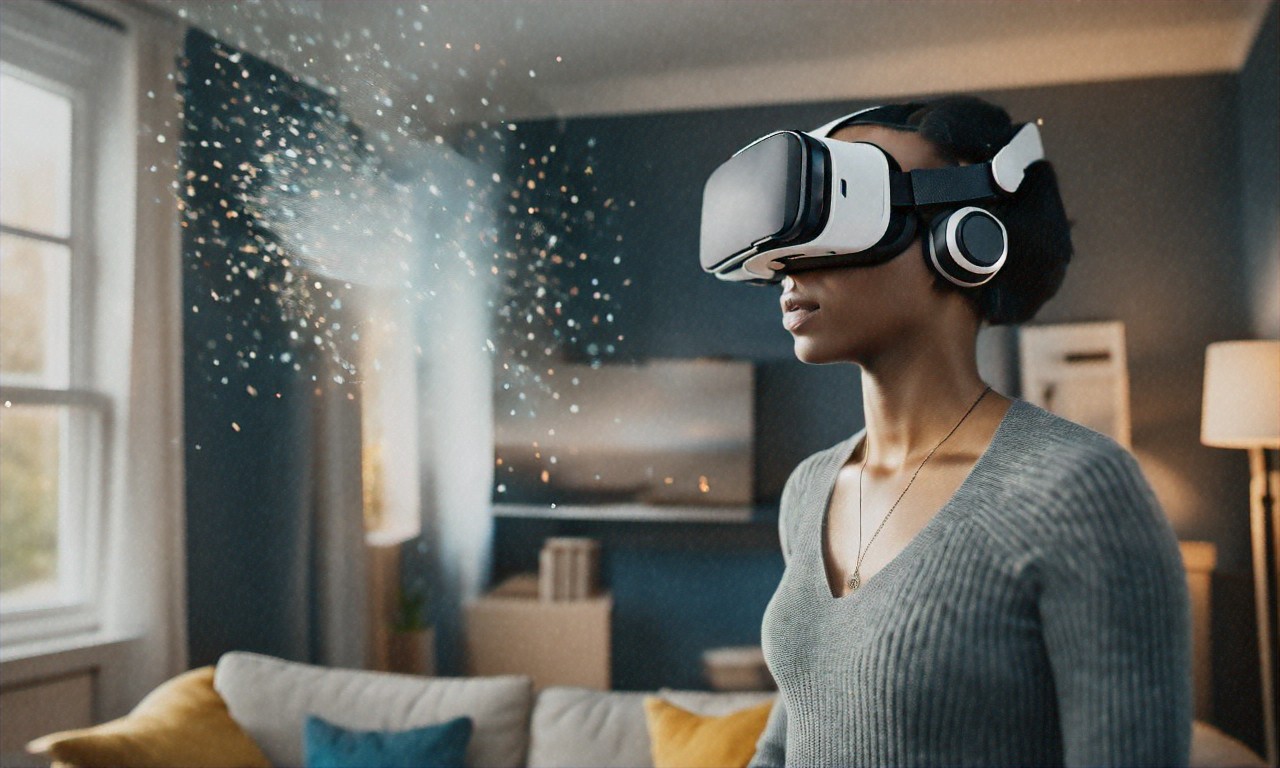
A long-time VR user’s honest read on where headset gaming actually stands in 2026, what genuinely improved, and what still gets in the way.
Somebody sent me a piece last week arguing that VR gaming is “still years away from mattering,” and I sat with that for a minute before I got annoyed. The complaints were the same ones people recited in 2019. Headsets too heavy. Games are just tech demos. Everyone throws up after twenty minutes. Fair enough, once. But writing that in 2026 is a bit like reviewing a restaurant off a meal you had there in 2019, then sounding shocked the menu moved on.
I’ve been wearing these things since the early Oculus dev kits, back when the resolution made the whole world look like you’d shoved your face into a screen door. Tracking dropped out if you so much as turned your back to the camera. The “games” were mostly proof-of-concept stuff nobody opened twice. So I understand the skepticism. I lived it. What bugs me is that the gap between what people still picture and what the hardware quietly became has gotten really wide, and the loudest takes are written by folks who tried a headset once at a friend’s place around 2018 and filed it under “neat, not for me.”
I want to be careful here, though, because the hype side lies too. VR is not on the cusp of eating your TV. It hasn’t, and I’d guess it won’t. Most nights I’m still on a flat monitor like everybody else. The honest story is smaller and more interesting than either camp wants. A stack of unglamorous improvements landed at roughly the same time, a couple of them genuinely big, and what you get out the other end is a thing worth owning for specific reasons rather than a revolution you’re obligated to join. Let me walk through what I can actually stand behind.
the headsets got lighter and sharper, and a lot less of a hassle
Standalone is where most of the volume lives now, and the Quest line carried that. Back in 2020 the Quest 2 arrived on a Snapdragon XR2, and it was the headset that got VR into a lot of houses purely because it was cheap and needed no PC. Then came the Quest 3 in 2023 on the newer XR2 Gen 2 chip, with the Quest 3S landing in 2024 as the budget take on that same generation. I’ll be blunt about something, since the fabricated “I tested the brand-new flagship” genre is everywhere: there is no Quest 4 you can buy as I write this. Anyone reviewing one is making it up. The real progress across the 2 to 3 jump was real enough without inventing a sequel.
And the jump mattered. Quest 3 pulled the standalone library forward in a way you feel rather than read off a box. Pancake lenses replaced the older Fresnel stack, so the headset got slimmer up front and the sweet spot widened. That last bit sounds dull until you’ve spent years inching a headset around your skull hunting for the one angle where menu text snaps into focus. Reading in-game stopped being a chore. Mundane, I know, but it’s exactly the kind of friction that quietly decides whether you keep a thing on for two hours or yank it off after twenty minutes.
Weight and balance improved across the generation, and the broader trend over the years is unmistakable: the things keep shedding grams and shifting mass off the front of your face. I won’t quote you an exact figure for any model, because half the spec numbers floating around online are wrong and the rest depend on which strap you bolted on. What I’ll say is that the difference between a 2020-era headset and a well-strapped current one is the difference between counting the minutes and forgetting you’ve got it on. Battery is still the nag it’s always been. A couple of hours of standalone play and you’re reaching for a cable or one of those battery straps, which double your runtime and, as a side benefit, counterweight the thing nicely. I treat the strap as part of the purchase, not an extra.
Passthrough is the upgrade I’d point a doubter at first. Old headsets handed you a grainy, sometimes black-and-white feed of your room when you neared the boundary, all security-camera-circa-2004 energy. The Quest 3 and the Vision Pro moved that to full color and sharp enough that mixed-reality games, the ones layering virtual stuff onto your actual furniture, finally land instead of reading as a parlor trick. I’ve played a few where little creatures skittered across my real coffee table, and that blend of real and virtual has crossed from gimmick into something that, to my mind, genuinely matters for a chunk of what VR becomes. Could be wrong about how fast it spreads. But the tech is no longer the bottleneck.
The other quiet revolution, and if you make me pick one change as the most important of the last few years, it’s this: the cable mostly died for PC VR. Wireless streaming over good home Wi-Fi got reliable. Virtual Desktop, a third-party app that arguably did more for wireless PC VR than any headset maker, is polished to the point that I rarely bother with a link cable anymore. On a solid 5GHz or Wi-Fi 6/6E router in the same room, the picture holds up and the lag stays low enough that I’ve played through whole sessions of demanding PC titles without fighting it. The freedom is the actual payoff. Swinging your arms around in a melee game without a wire wrapping your shins is the difference between immersion and irritation, and just about everyone I’ve handed a wireless setup to says some flavor of “okay, I get it now.”
sony’s headset got written off too early
The PSVR2 launch in February 2023 was bumpy, no argument. It locked to the PS5 by a single cable, the library was thin, and the price made people wince next to a standalone Quest. Plenty of folks crossed it off right there. What got missed is that Sony didn’t let it quietly die the way these side projects usually do. They added PC support, with the PlayStation VR2 PC adapter arriving in August 2024, which cracked the headset open to the SteamVR library.
Hardware was never the weak spot. OLED panels with HDR, eye tracking built in, and those Sense controllers with adaptive triggers that actually make a tense weapon pull feel different from a relaxed one. What it lacked early on was games. That’s the part that filled in. I’d hand a skeptic Gran Turismo 7’s VR mode, which got added free to the game back in February 2023, as the demo that flips them. You drop into the cockpit, check your mirrors by turning your head, glance down at the dash, and the sense of actually sitting in a car is uncanny in a way a flat screen can’t touch. Then there’s Horizon Call of the Mountain, the PSVR2 launch showcase from Guerrilla and Firesprite, still one of the better-looking things on the headset, all that vertigo when you’re scaling a cliff with a machine the size of a bus stomping below. Resident Evil Village got a free VR mode for PSVR2, and Resident Evil 4 has its VR versions too, and survival horror in a headset hits in a way I won’t spoil for you. Just maybe don’t start there if you’re new.
One caveat people gloss over. The PC adapter route is not the clean handoff it sounds like. On a PC the PSVR2 quietly drops some of the stuff that makes it special, eye tracking and HDR among them, and plenty of SteamVR games never touch the adaptive triggers in the first place, so what you’ve actually bought yourself is access to thousands more titles at the cost of an experience that feels noticeably more uneven than the native PS5 pipeline. Already own a PS5 and a capable gaming PC? Then the headset earns its keep across both. Only one of those? Temper expectations.
Then there’s the headset I keep having to talk people into taking seriously for games, and I say that as someone who was a skeptic myself. The Apple Vision Pro. Apple shipped it in early 2024 at around $3,499 and pointedly refused to call it a VR headset. It’s a “spatial computer,” all productivity and movies and carefully vague “experiences,” and Apple’s developer guidelines literally steer studios away from gaming language. So I’m not going to hand you a list of must-play Vision Pro exclusives, because frankly the killer gaming library isn’t the story here and I’d be inventing it if I claimed otherwise. What’s real is the display. Those micro-OLED panels are the sharpest I’ve looked through in any consumer headset, close enough to looking through a window that you stop registering it as a screen. Apple refreshed the internals with an M5 model in late 2025. For anyone who already owns one for work, the spatial and immersive content on it is a genuine perk. As a thing you’d buy purely to game on, at that price, I can’t recommend it with a straight face, and I won’t pretend the catalog justifies it.
The PC crowd should know about the Bigscreen Beyond, which proved how small a tethered headset can get. It launched in 2023 at around 127 grams, with a custom face mask molded to a scan of your own face, micro-OLED panels, and it leans on the same SteamVR base-station tracking the Index uses. Bigscreen announced a Beyond 2 in 2025 with adjustable IPD and an eye-tracking variant. Niche. Enthusiast. Base stations and controllers cost extra, so it’s nobody’s starting point. But it shows the form factor everyone keeps chasing, that thick-glasses dream, is already reachable if you’ve got the money.
the library has actual depth now
The lazy line is that VR is Beat Saber and a pile of tech demos. Beat Saber’s still going, and we’ll get to why in a second, but the catalog underneath it is deeper than it’s ever been. Let me run through what I’ve genuinely put hours into rather than rattle off a store page.
Half-Life: Alyx, Valve’s 2020 release, remains the one people point newcomers toward, and it deserves it. The physics, the gravity gloves, the gunplay, the way the world reacts to your hands, all of it still feels ahead of most of what’s come since. It’s single-player. I mention that flatly because I’ve seen claims of an official co-op mode floating around and there isn’t one. A solo experience through and through, and so good as a solo experience that the absence never once bothered me.
For the “VR has no real RPG” crowd, Asgard’s Wrath 2 is the rebuttal. Note the number, it’s the second one, and it shipped in December 2023, given away free with the Quest 3 at launch. It’s a big sprawling action RPG, melee and magic plus those environmental puzzles that lean on your actual hands, and the whole thing runs natively on standalone hardware with no PC anywhere in the loop. The combat is where it sells itself. There’s a satisfying heft to a swing, that little jolt up through the controller when you connect, and some dumb part of your arm half-believes it hit something solid. Closest the standalone library has come to a real single-player epic.
Beat Saber, somewhere past six years on, still sits near the top of the sales charts, and the reason is the community more than the official tracks. Custom songs, custom sabers, custom environments, multiplayer. The skill ceiling is genuinely absurd, I think I’m decent right up until I watch expert footage and feel like I’m observing a different species. It’s also still the best on-ramp there is. Hand someone the controllers, queue a song they know on an easy difficulty, and they’re grinning inside a minute. There’s a reason it’s the demo everybody reaches for.
On the multiplayer shooter side, things finally have enough warm bodies to be worth playing. Pavlov is the social FPS staple, with modes running from tactical rounds down to zombies and that Trouble in Terrorist Town party mode. One wrinkle: there’s a separate standalone Quest build alongside the PC version, so check which one your friends are on before you assume you’ll match up. Contractors keeps a community busy with custom maps and modes. And if you want your palms sweating, Ghosts of Tabor is the extraction shooter people compare to Tarkov, where you drop into a hostile zone, scavenge what you can, then try to get out alive past other players before the clock runs you out. It runs across PCVR and Quest and PSVR2 with crossplay, all sharing one matchmaking pool, so you’re never short of opponents. In VR every action is physical, you spin to check a sound behind you, you actually eject a magazine to reload, and that turns a tense loop into something genuinely nerve-wracking. Not for everyone. For the people it’s for, nothing else scratches it.
None of this means the catalog is bottomless. There’s still a lot of shovelware, a lot of half-finished early-access stuff, and plenty of games that are clever for an hour and empty after. But the floor came up and the ceiling went way up, and that’s the part the “tech demos” line never accounts for.
fitness is the quiet reason headsets sneak into normal houses
I was a hardline skeptic here for years. Flapping at colored blocks isn’t a workout, come on. Then I strapped a heart-rate monitor on during sessions and the numbers shut me up. A serious round of boxing in VR keeps me parked in real cardio territory, the kind of sustained effort I never manage on a treadmill because the treadmill is boring and the game isn’t. The Thrill of the Fight 2 is the one I’d cite for that, the boxing sim from Halfbrick built with the creator of the original, which hit its 1.0 in late 2025 after a stretch in early access. It is exhausting in the best way.
Beyond boxing, Supernatural folded into Meta’s fitness offering, FitXR, and Les Mills Body Combat all run structured workouts that go well past lazy arm-waving. Les Mills especially, since it’s adapted from their real group classes, has you punching and squatting and lunging through actual choreography. The person in my house who could not care less about gaming uses one of these most days a week and has stuck with it longer than any gym membership we’ve ever paid for. She’d never have bought a headset to play games. Bought it for the workout, full stop. And that one fact reframed the whole category for me, because a gaming gadget is a hard sell to most households, whereas a workout someone will actually keep doing opens the door a lot wider. I suspect a real slice of the next wave of buyers comes in through fitness, though I’d hold that loosely rather than state it as fact.
The old motion-sickness knock deserves an honest answer too, because it was real. Early VR was rough on the body, low refresh rates and shaky tracking and locomotion systems that picked a fight with your inner ear. Where is it now? Better. Not solved, but a lot better, and improving for two separate reasons. The hardware side: higher refresh rates, lower-persistence displays, and steadier tracking shrink the mismatch between what your eyes report and what your balance expects. The design side, which matters just as much: developers figured out what makes people queasy and built around it. Teleport movement, snap turning, vignettes that narrow your view while you move. Comfort settings ship standard in nearly every decent title now, with a range from full smooth locomotion for veterans down to gentle options for nervous first-timers. My standing advice to newcomers is to start stationary, something like Beat Saber, give it a week, then ease into games with movement. Jumping straight into a fast shooter on day one is how you book yourself a bad afternoon.
where it still falls short
Pretending the rough edges are gone is how you end up writing a press release instead of a review, so here’s the honest ledger. Input first. Controllers are good now, the Quest’s Touch controllers and the PSVR2 Sense controllers are precise and comfortable. But under the polish they’re still plastic sticks in your fists, and the dream of ditching them hasn’t arrived. Hand tracking has genuinely improved, it’s fine for menus and slower experiences, and then it falls apart the second you need a real button press or precise analog input. Sure, you can technically attempt a competitive shooter on hand tracking alone. You’ll lose, badly. Not there yet.
Space is the wall a lot of people hit before they even start. You want a clear patch of floor, a couple of meters square for standing play and more again for proper room-scale, and a surprising number of homes simply don’t have that going spare once you account for furniture. I converted a whole spare room into a VR space. I’m well aware that’s a luxury most people can’t hand over. Seated stuff is fine, racing and flight sims, the social apps. But the experiences that truly sell VR want you moving, and movement wants floor.
Fragmentation grates on me more the longer it drags on. Quest has the biggest library by a wide margin. Sony’s headset has its exclusives plus the PC route. Vision Pro sits off in its own walled garden. Cross-buy barely exists, so owning a game on one platform usually means starting from zero on the next. What a mess, and I’m not optimistic it gets tidied up soon, because none of these companies has a strong reason to play nice with the others.
Social is a split decision. The person wearing the headset is cut off from everyone else in the room, that’s just how it works. Casting your view to a TV helps, and mixed-reality capture lets you film the player and the virtual scene together, but there’s still something faintly absurd about watching someone flail around blind while you squint at a flat slice of what they’re seeing. Inside VR, though, the social side surprised me. VRChat is still the chaotic, creative, occasionally deeply strange place it always was. Rec Room keeps pulling in a younger crowd. Even Horizon Worlds, mocked relentlessly over its once-legless avatars, grew into a fine enough place to hang out. What caught me off guard was a live event, standing in a virtual crowd with thousands of other real people all reacting together. Typed out it sounds silly. From the inside, wrapped in that collective noise, it felt more social than any stream ever has for me.
As for what’s next, I’ll keep the predictions modest. Eye tracking will probably spread, which unlocks foveated rendering, where the headset draws full detail only where you’re looking and pockets the saved processing for everything else. Haptics are creeping past controllers toward vests and gloves, slowly, still pricey. And the headsets keep shrinking toward something closer to thick glasses than ski goggles, which is the form factor that probably decides whether any of this goes truly mainstream. But honestly the change I care about most already happened, and it isn’t a spec. Five years ago VR was a curiosity you tried once and didn’t buy. Now it’s a real platform with a deep library, headsets in millions of homes, and games that stand on their own merits. It hasn’t replaced flat-screen gaming and it doesn’t need to. All it ever had to do was stop being a novelty, and that part it managed. The people who quit back in the dev-kit days, squinting through that screen door, mostly have no idea it’s gone. Writing the whole thing off from a memory that old is the actual mistake, but that’s a rant for another day.
(0) Comments