The first deep-field image from the James Webb Space Telescope showed galaxies that formed 300 million years after the Big Bang. That alone would’ve been enough to justify the billion price tag. But then the data kept coming — and it broke things. Galaxies that were too big, too bright, too structured for how young they were. Stars with chemical signatures that didn’t match any model we had. An atmosphere on a rocky exoplanet. The telescope has been operating for about three years, and it’s already forced revisions to theories that held up for decades.
I’ve been following Webb’s output since July 2022, when that first deep field image dropped and the internet collectively lost its mind over how pretty it was. Pretty. Sure. But the science buried in those pixels? That’s where the real story sits, and it’s way messier than the press releases suggest.
So let me walk through what Webb has actually found, why so much of it doesn’t fit neatly into existing theory, and why I think we’re probably going to spend the next twenty years scrambling to catch up with this machine.
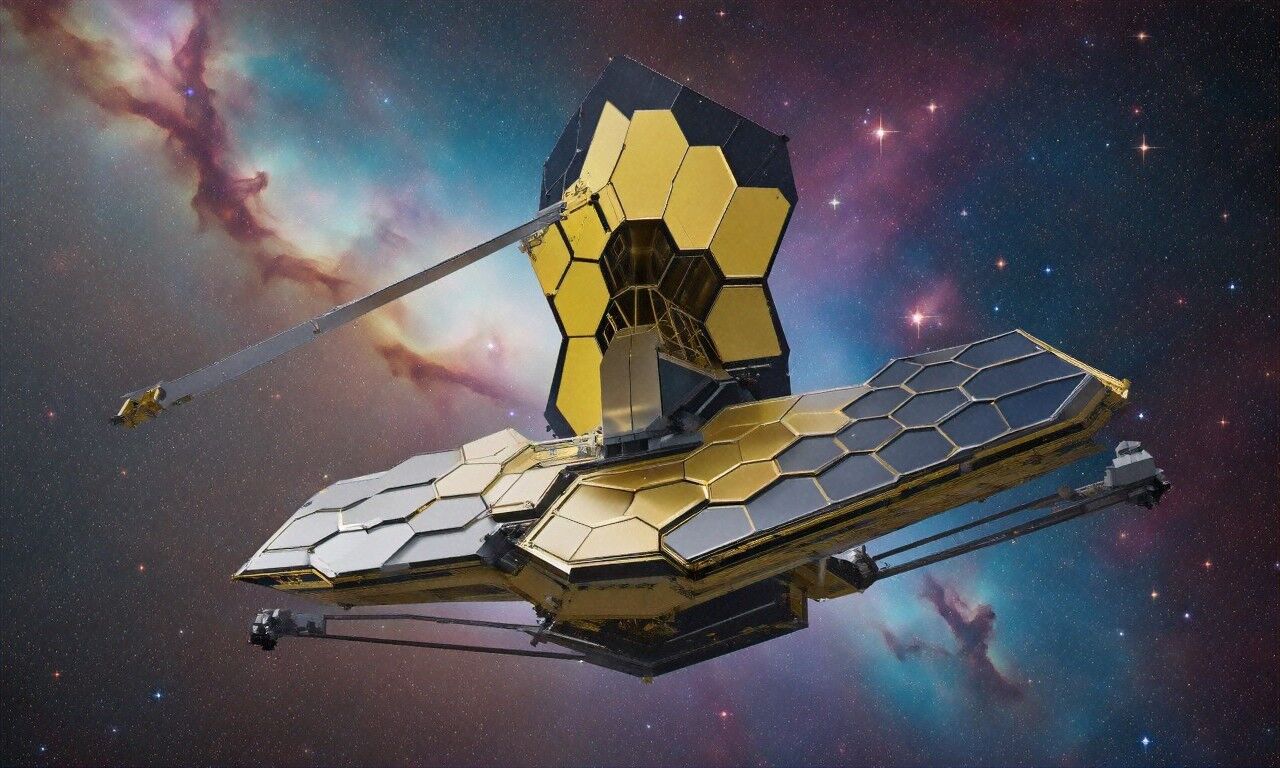
Before any of the discoveries make sense, you need to understand what Webb actually is and why it sees differently than anything we’ve had before. It’s parked at the second Lagrange point — L2 — roughly 1.5 million kilometers from Earth, about four times farther out than the Moon. A sunshield the size of a tennis court, five layers of Kapton thinner than a human hair, keeps the instruments chilled to around minus 233 degrees Celsius. That kind of cold matters because Webb works in infrared. Heat is noise. To pick up the faintest infrared glow from objects 13 billion light-years away, the telescope itself has to be almost as cold as the void it’s staring into.
Its primary mirror spans 6.5 meters — 18 hexagonal gold-coated segments arranged in that honeycomb shape you’ve seen everywhere. Gold reflects infrared light extremely well, which is the whole point. Compared to Hubble’s 2.4-meter mirror, Webb collects roughly seven times more light. But size isn’t even the main advantage. Wavelength is. Hubble sees mostly visible and ultraviolet light. Webb sees infrared, and that single difference changes everything. Dust clouds that block Hubble’s view? Transparent to Webb. Light from objects so distant that cosmic expansion has stretched it beyond the visible spectrum? Webb catches it. Heat signatures from alien planets? Webb reads them like a thermometer.
Four instruments do the heavy lifting: NIRCam for near-infrared imaging, NIRSpec for near-infrared spectroscopy, MIRI for mid-infrared work, and NIRISS for slitless spectroscopy. Together they can image objects, break their light into spectra, and characterize everything from nearby moons to the earliest galaxies. I probably don’t need to belabor the point, but this is, by a wide margin, the most capable observatory humanity has ever put into space.
Now. The discoveries. And why they’re causing problems.
That first deep field image — officially targeting the galaxy cluster SMACS 0723, about 4.6 billion light-years from us — wasn’t just a prettier version of Hubble’s deep fields. SMACS 0723 acts as a gravitational lens. Its mass bends and magnifies light from far more distant galaxies lurking behind it. Webb’s infrared eyes revealed galaxies Hubble had never detected: faint, ancient objects whose light had been traveling since the universe was less than a billion years old.
And here’s where things got frustrating for theorists. There were too many of them. Way too many. Standard cosmological models predicted a certain population of galaxies at these extreme distances, and Webb was finding three to ten times more than expected in some surveys. These weren’t dim little smudges, either. Many appeared bright, massive, surprisingly mature — as if they’d been forming stars for hundreds of millions of years in a universe that was itself only 400 or 500 million years old. The math, as one cosmologist at the University of Texas put it to me while shaking her head, “gets uncomfortable.”
This wasn’t some minor statistical wrinkle. It suggested galaxy formation kicked off earlier and ran faster than anyone’s models could account for. Or — and this possibility keeps certain people awake at 2 AM — something about our understanding of the early universe needs serious revision. Maybe both. Hard to say right now.
Several of those early galaxy candidates were eventually confirmed through spectroscopy. JADES-GS-z13-0, for instance, turned out to be a genuine high-redshift galaxy existing when the universe was just 320 million years old. For context: the universe is 13.8 billion years old. Finding a well-formed galaxy at 320 million years is like showing up to a construction site where the foundation was poured yesterday and finding a fully furnished house.
And then they found one even farther.
The JADES program — JWST Advanced Deep Extragalactic Survey — produced the deepest infrared images ever taken of the sky. From that dataset emerged JADES-GS-z14-0, confirmed at a spectroscopic redshift of 14.32. That puts it just 290 million years after the Big Bang. As of early 2025, it’s the most distant galaxy ever confirmed with spectroscopy.
But distance records alone don’t make astronomers nervous. What made them nervous was the galaxy’s properties. JADES-GS-z14-0 is surprisingly luminous. Its light appears to come from stars, not from an active galactic nucleus gobbling matter around a supermassive black hole. So this tiny thing, existing when the universe was barely 2% of its current age, had already assembled a real population of stars. That ripples through star formation theory, dark matter halo models, everything we think we know about the first stellar generations.
A member of the JADES team told me about the moment the spectroscopic confirmation landed. She ran the reduction pipeline three times because she didn’t trust it. Then she called her collaborator in Edinburgh at 3 AM his time. “I think we broke the record again,” she said. He asked by how much. “Enough to be scared.” She meant scientifically scared — that gut-level apprehension when your data tells you your models aren’t complete.
I find it telling that the reaction among specialists wasn’t celebration. It was anxiety. That should tell you something about how well our existing framework handles what Webb is showing us.
While distant galaxies grabbed headlines, some of Webb’s most consequential work happened much closer. WASP-39b is a gas giant about 700 light-years away, roughly Saturn’s mass but bloated larger than Jupiter because it hugs its star so tightly the atmosphere puffs out from the heat. Nobody thinks there’s life there. But WASP-39b became the testing ground for something far more important: the most detailed chemical analysis ever performed on an alien world’s atmosphere.
Transmission spectroscopy is the trick. When WASP-39b crosses in front of its star, starlight filters through the planet’s atmosphere on its way to Webb. Different molecules absorb different wavelengths, leaving chemical fingerprints. Hubble could do this in a rough, squinting sort of way. Webb turned it into precision chemistry. Five papers published in early 2023 laid out the results: carbon dioxide detected in an exoplanet atmosphere for the first time ever, along with water vapor, sodium, potassium, and — here’s the kicker — sulfur dioxide.
Sulfur dioxide wasn’t on most people’s bingo cards. On WASP-39b, it’s produced by photochemistry: ultraviolet light from the host star drives reactions in the upper atmosphere, creating SO2 from other sulfur compounds. First direct evidence of photochemistry happening on an exoplanet. That matters enormously, because photochemistry drives atmospheric evolution, and understanding it is probably a prerequisite for detecting biosignatures on habitable worlds someday.
“The atmosphere isn’t just sitting there passively,” an atmospheric chemist at MIT told me. “It’s reacting, being shaped by radiation in ways we can now actually measure. That’s a giant step toward studying the atmospheres of smaller, rocky planets — the ones where we might eventually detect biology.” And that’s the real point. Nobody cares about WASP-39b for its own sake. They care because the techniques proven there are the exact same techniques scientists will use when they point Webb at an Earth-sized world in a habitable zone. WASP-39b was the dress rehearsal. The real performance is coming.
Among the five initial images released in July 2022 was a view of the Carina Nebula’s “Cosmic Cliffs” — the edge of a giant gas cavity in NGC 3324, about 7,600 light-years out. Hubble had photographed this region before and the results were already beautiful. Webb’s version made Hubble’s look like it was shot through frosted glass. Infrared vision sliced through the dusty outer layers and revealed hundreds of previously hidden young stars, many still cocooned in the gas pillars they were born from.
Visually stunning, sure — amber and bronze clouds sculpted into formations that looked like alien mountain ranges, bright young stars scattered across the peaks. But the science was what mattered. Astronomers identified dozens of protostellar jets, narrow beams of superheated gas blasting outward from newborn stars at hundreds of kilometers per second. These jets are how forming stars shed angular momentum so material can keep falling inward. Webb caught them in absurd detail. Structures that had been theoretical were now sitting right there on the screen.
An astrophysicist at the European Space Agency who’s been working through the Carina data told me they’re watching the first few hundred thousand years of a star’s life in real time — a cosmic eyeblink. “Before Webb, we could model these early phases, but we couldn’t observe them directly because dust was in the way. Now the dust is transparent. We’re watching stars being assembled, and some of what we’re seeing doesn’t match our simulations.” She pointed out several objects with asymmetric jets — stronger on one side — that the models hadn’t fully predicted. Another thing to go back and fix.
Follow-up observations of the Orion Nebula and the Serpens Nebula extended these findings. In Orion, Webb revealed protoplanetary disks around young stars with clarity nobody had achieved before, showing the structures from which solar systems get built. Some disks had gaps and rings suggesting planets were already forming inside them — worlds under construction even as their parent stars hadn’t finished settling into steady hydrogen burning. It’s messy and chaotic and beautiful and deeply confusing all at once.
Now for something that I think might end up being the most disruptive finding of all, though it’s too early to be certain. Webb has discovered supermassive black holes in the early universe that are far too massive to exist under standard formation models. Conventional wisdom says supermassive black holes grow by accreting matter and merging with each other over billions of years. They start as smaller seed black holes — maybe remnants of the first giant stars — and bulk up gradually. The monsters sitting at the centers of today’s galaxies, weighing millions or billions of solar masses, are supposed to be the end product of that slow growth.
Except Webb is finding black holes that already weigh millions of solar masses when the universe was only 500 to 700 million years old. Not enough time. Not even close. The most dramatic example sits in the galaxy UHZ1, gravitationally lensed by the cluster Abell 2744. Combining Webb infrared data with X-ray observations from the Chandra telescope, researchers found this black hole had a mass comparable to its entire host galaxy. In the local universe, supermassive black holes are typically a tiny fraction of their galaxy’s mass. This ratio was wildly off.
It’s revived serious interest in what used to be a fringe idea: direct collapse. Rather than growing from small seeds, some supermassive black holes might have formed directly when enormous clouds of pristine hydrogen gas collapsed wholesale, skipping the intermediate stages. If conditions lined up — a massive gas cloud with no metals to promote fragmentation, intense background radiation suppressing normal star formation — the whole cloud could theoretically crumple into a single black hole weighing tens of thousands of solar masses from day one.
“Direct collapse was a fringe idea five years ago,” a black hole theorist at Yale told me. “Webb’s data has made it mainstream. We’re now seriously considering that the first black holes were born heavy. That changes our entire picture of structure formation — galaxies and black holes may not have grown together the way we assumed. The black holes might have come first.” If that holds up, and I think it might, it’s a fundamental rethinking of galaxy evolution. Papers are coming out almost monthly trying to work through the implications.
In September 2023, Webb pointed at K2-18b, a planet 8.6 times Earth’s mass orbiting a red dwarf star 120 light-years away. It sits in its star’s habitable zone, where liquid water could theoretically persist on the surface. Too large to be a rocky world like ours, K2-18b is probably a sub-Neptune — possibly what’s called a Hycean world, with a thick hydrogen atmosphere sitting on top of a global water ocean.
Webb’s spectroscopic analysis found methane and carbon dioxide in the atmosphere. That’s consistent with what you’d expect if there’s an ocean underneath, with carbon cycling between atmosphere and liquid surface. But then came the headline-grabber: a tentative, heavily caveated hint of dimethyl sulfide — DMS. On Earth, DMS is produced almost exclusively by marine phytoplankton. It’s biological. If confirmed on K2-18b, it’d be the first detection of a potential biosignature on another world.
I want to be careful here because the community was careful. The DMS signal was faint, sitting right at the edge of what’s detectable, and independent analyses disagreed about its statistical significance. The lead author was explicit: “We’re not claiming we found life. We’re saying we found a molecule that, on Earth, is associated with life. On K2-18b, there could be non-biological explanations we haven’t considered.” More Webb observations were scheduled through mid-2024, with results still being analyzed as of recently.
Whether the DMS signal survives or not — and I’m genuinely unsure which way it’ll go — K2-18b has become the most intensively studied potentially habitable exoplanet in history. The sheer fact that Webb can detect trace atmospheric compounds on a world 120 light-years away means the search for biosignatures isn’t hypothetical anymore. It’s happening. Right now. We’re doing it.
And Webb hasn’t only been staring at distant worlds. In May 2023, it observed Enceladus — Saturn’s small icy moon — and captured a water vapor plume erupting from the south polar region that extended nearly 10,000 kilometers into space. Forty times the moon’s own diameter. The Cassini spacecraft had already confirmed that Enceladus has a subsurface ocean and vents water through cracks in its ice shell, but nobody anticipated plumes this enormous.
The water output was staggering. Roughly 300 liters per second spraying into the void. A lot of that water disperses into a donut-shaped torus feeding Saturn’s E ring. Some falls back onto Enceladus itself, potentially cycling material between the subsurface ocean and the surface — which could matter for chemistry and, speculatively, for biology down there.
A planetary scientist at Southwest Research Institute put it simply: “Cassini flew through the plumes and tasted them up close, but it couldn’t step back far enough to see the full scale. Webb can. And the full scale is bigger than we thought.” These observations have strengthened the argument for a dedicated Enceladus mission — a spacecraft that could fly through those plumes, grab water samples, and analyze them for complex organics or other potential biosignatures. If the ocean is gushing its contents into space, we don’t need to drill through the ice. We just need to catch the spray.
Webb’s infrared capabilities have also peeled back layers on how nearby galaxies actually work. Through the PHANGS survey — Physics at High Angular resolution in Nearby Galaxies — the telescope has imaged 19 galaxies in infrared, creating the most detailed atlas of galactic structure ever assembled. Galaxies like NGC 628, the Phantom Galaxy, and NGC 7496 revealed intricate webs of dust lanes, gas filaments, and embedded star-forming regions that are completely invisible in optical light.
Dust, it turns out, isn’t just an obstruction. It’s a tracer. Dust emission patterns map where gas is being compressed by spiral density waves, where supernovae have blown cavities in the interstellar medium, where new stars are about to ignite. In several galaxies, Webb uncovered populations of deeply embedded star clusters that optical surveys had missed entirely. And these hidden clusters changed estimated star formation rates by 20 to 30% in some cases.
“We thought we had a good census of star formation in nearby galaxies,” a PHANGS team member told me. “Webb showed us we were undercounting by a significant margin. That’s not a small correction. It means the universe is forming stars faster than we realized, which feeds into chemical enrichment, stellar feedback, galaxy evolution — basically everything downstream.” The infrared window isn’t just adding resolution to what we already knew. It’s revealing entire populations and processes that were hidden from us.
Webb was designed for at least five years of operation, but an exceptionally accurate launch by the Ariane 5 rocket saved so much maneuvering fuel that it could conceivably operate for twenty years or more. We’re still in the early chapters. Upcoming observation cycles include deeper surveys of the ancient universe, targeted atmospheric studies of rocky exoplanets in the TRAPPIST-1 system, solar system monitoring, and follow-ups on every major finding so far.
And the telescope has already reshaped what comes after it. The Habitable Worlds Observatory, still in its earliest planning stages at NASA, would be a large optical and ultraviolet telescope specifically built to directly image Earth-like exoplanets and search their atmospheres for signs of life. Webb proved atmospheric characterization works at interstellar distances. The next generation of telescopes will push those techniques toward smaller, cooler, rockier targets.
What bothers me — and I mean this in the most productive sense — is the pattern. Over and over, Webb has shown that the universe is more active, more complex, more surprising than our models predicted. Galaxies formed earlier. Black holes grew faster. Planetary atmospheres contain compounds nobody anticipated. Star formation runs hotter than we measured. Each of these represents a spot where reality outran theory, and each one opens a line of investigation that’ll keep researchers occupied for decades.
I asked one of the original Webb project scientists — someone who’d worked on the telescope for over fifteen years — what surprised him most about the first two years of operations. He thought about it for a long time. “The surprises,” he finally said. “Not any specific one. The sheer number. We built this machine to answer questions. Instead, it’s asking them.” He paused. “That’s exactly what a great telescope should do.”
I’m still working this out, honestly. I don’t have a tidy thesis about what Webb “means” for humanity or whatever grand narrative people want to impose on it. Maybe nobody does yet. The data is still pouring in faster than theorists can process it, and every month seems to bring another result that breaks something we thought we understood. I could be wrong about some of the implications I’ve laid out here — some of these early findings might get revised or reinterpreted as more data accumulates. What I’m fairly confident about is that we won’t look back on this telescope the way we look back on most scientific instruments. Webb isn’t just filling in gaps. It’s redrawing the map while we’re still trying to read it. And honestly, I’m not sure any of us — scientists, journalists, anyone — have fully caught up with what it’s telling us. Maybe that’s okay. Maybe the discomfort is the point.
(0) Comments