David was nineteen when doctors pulled stem cells from his bone marrow, edited a single gene using CRISPR-Cas9, and put them back. Eight months later, for the first time in his life, he went an entire season without a sickle cell crisis. No emergency room visits. No transfusions. No pain episodes that left him unable to move for days. He’d been hospitalized over forty times before that procedure. Now he plays pickup basketball on weekends.
Then doctors pulled stem cells from his own body, edited a gene called BCL11A with CRISPR-Cas9, and put those cells back. That one edit flipped the switch on fetal hemoglobin production, a protein that basically overrides the sickle cell mutation. When I saw him in that clip, his hemoglobin levels were normal. First time ever. “I don’t even know how to describe it,” he said. “I just feel.. normal.”
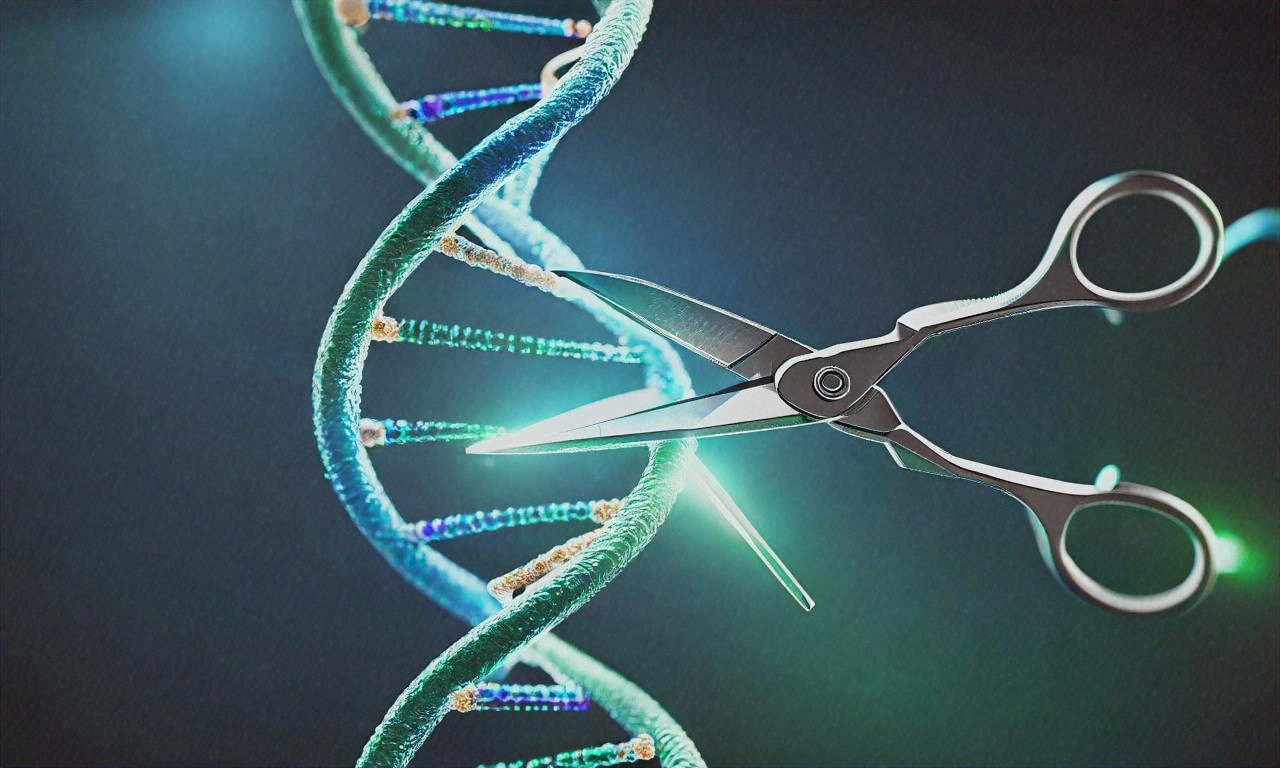
And I’m sitting there thinking: we borrowed molecular scissors from bacteria. Bacteria. That’s where this whole thing started.
Borrowed From Bacteria
So bacteria have this immune system, right? They store little snippets of viral DNA, kind of like a mugshot book, so they can spot invaders and chop them up. Scientists call it CRISPR, which stands for Clustered Regularly Interspaced Short Palindromic Repeats. Terrible name, amazing trick. In 2012, Jennifer Doudna at UC Berkeley and Emmanuelle Charpentier (she was at Umea University in Sweden at the time) published a paper showing you could reprogram this system. Design a short guide RNA that matches whatever DNA you want to target, pair it with the Cas9 protein, and boom, it finds and slices that exact stretch of DNA.
Labs went wild. Months. That’s all it took. Researchers around the world were editing genes in mice, zebrafish, plants, human cells grown in dishes. The cost dropped through the floor: maybe a few hundred bucks for materials that used to run tens of thousands with older methods like zinc finger nucleases or TALENs. A competent grad student could pull it off in days instead of months. I don’t think biology had seen anything shake things up like this since PCR came along in the 1980s.
Doudna and Charpentier picked up the Nobel Prize in Chemistry in 2020. By then CRISPR had already spun off dozens of biotech companies, hundreds of clinical trials, thousands of papers. But speed has a shadow. Everybody was moving so fast that some big, uncomfortable questions kept getting pushed to “later.” And then a physicist in China made “later” arrive way ahead of schedule.
He Jiankui and the Line That Got Crossed
November 2018. A Chinese biophysicist named He Jiankui uploads a YouTube video. Calm, almost casual. And what he says is staggering, he’d used CRISPR to edit human embryos. Not cells in a dish. Living embryos that were carried to term. Twin girls, called Lulu and Nana in the press, born with modifications to a gene called CCR5. That’s the gene encoding a protein HIV uses as a doorway into cells. He said he was protecting them from HIV.
Scientists didn’t just push back. They were horrified. Angry, sure, but something deeper than anger. He’d crossed what most researchers saw as the clearest ethical boundary in genetics: heritable genome editing. Those changes weren’t just in the twins’ cells. They were in every cell, including their eggs. Meaning they’d pass the edits to their own children someday. And, this is probably the worst part) the work was sloppy. Later analysis showed the edits were incomplete. Some cells were modified, others weren’t. Mosaic, they call it. The HIV protection? Uncertain at best. Off-target effects, where CRISPR accidentally cuts DNA in the wrong spots? Nobody could rule them out. We might not know the full damage for decades.
He Jiankui got condemned from pretty much every direction. The Second International Summit on Human Genome Editing happened to be going on in Hong Kong right when the news broke, and it turned into wall-to-wall outrage. Nobel laureate David Baltimore, who chaired the summit, called it “irresponsible.” China’s government investigated, convicted him, sentenced him to three years in prison. He got out in April 2022.
But what stuck wasn’t the prison sentence. Two girls are out there, growing up, carrying edits no one fully understands. And the whole field had to face something it’d been tiptoeing around: if a relatively small lab can pull off germline editing with CRISPR, what stops the next person from trying? Who decides what’s okay? And what governance structures need to exist before anyone should even consider heritable changes?
The Quieter Work That Actually Paid Off
While He Jiankui sucked up all the oxygen, a much more careful effort had been grinding through clinical trials. Sickle cell disease and beta-thalassemia, two genetic blood disorders that hit millions of people, especially in sub-Saharan Africa, India, and around the Mediterranean. Both caused by hemoglobin gene mutations. Both can be brutal.
Vertex Pharmaceuticals and CRISPR Therapeutics built a treatment called exa-cel, brand name Casgevy. Take a patient’s own bone marrow stem cells, edit them with CRISPR-Cas9 to crank up fetal hemoglobin production, put them back. The trial results? I think “extraordinary” probably undersells it. Out of 30 sickle cell patients followed for at least 18 months, 29 had zero vaso-occlusive crises, those devastating pain episodes that define the disease. For beta-thalassemia, 39 of 42 patients stopped needing blood transfusions entirely. People who’d been getting transfusions every few weeks just to stay alive.
December 2023: the UK’s Medicines and Healthcare products Regulatory Agency approved Casgevy. First CRISPR therapy approved anywhere on the planet. The US FDA followed shortly after. Proof (real, documented, clinical proof, that gene editing could move from bench to bedside and genuinely fix people’s lives.
Now here’s where it gets complicated. A single Casgevy treatment runs around $2.2 million per patient in the United States. And the process is rough, patients have to go through chemotherapy first to wipe out their existing bone marrow before the edited cells go in. Chemo brings risks: infection, infertility, and in rare cases, it can kill you. For someone with solid insurance in a wealthy country, this is a miracle. For the millions of sickle cell patients in Nigeria or the Democratic Republic of Congo or India, where the disease burden sits heaviest, it might as well not exist.
Base Editing: Smaller Changes, Bigger Potential
Even while first-generation CRISPR therapies were reaching patients, scientists had been tinkering with something more refined. Base editing, invented in David Liu’s lab at the Broad Institute back in 2016. Standard CRISPR chops the DNA double helix — then the cell tries to repair it, and sometimes repairs go sideways. Base editing skips the cutting entirely. It chemically swaps one DNA letter for another without ever breaking the strand. Think of it this way: regular CRISPR is scissors cutting a word out of a sentence, and base editing is an eraser changing one letter. Way less mess.
Two main flavors exist. Cytosine base editors turn C-G pairs into T-A pairs. Adenine base editors convert A-T pairs to G-C pairs. Between them, they can fix roughly 60% of all known disease-causing point mutations: those single-letter typos in DNA that cause things like progeria or certain types of blindness.
Verve Therapeutics is running a trial called VERVE-101 for heterozygous familial hypercholesterolemia. Sounds fancy, but it’s basically a genetic condition that jacks up your LDL cholesterol to dangerous levels, and it affects about 1 in 250 people. Their approach: edit a gene called PCSK9 in liver cells. One infusion, permanently lower cholesterol. Early results came out at the American Heart Association meeting in November 2023, showing real LDL reductions. If this holds up long-term, it could replace daily pills or biweekly injections for millions of people. That’s a big “if,” but it’s a pretty exciting one.
Beam Therapeutics (David Liu co-founded this one too) is going after sickle cell, leukemia, and a handful of other conditions with base editing. Their lead program, BEAM-101, targets sickle cell by making a single precise base change to activate fetal hemoglobin. Similar idea to Casgevy, but potentially cleaner. Fewer off-target edits. Less complex cell processing. Maybe, and I want to stress the “maybe” here) eventually cheaper and more accessible.
Cancer, Blindness, and a Whole Lot More
Blood disorders got the spotlight first, but CRISPR’s reach goes much further. Cancer is a major frontier right now. Multiple clinical trials are using CRISPR-edited immune cells to go after tumors. A common strategy: pull out a patient’s T cells, edit them so they’re better at spotting and killing cancer, then put them back. Carl June’s group at the University of Pennsylvania has been pushing hard on this, mixing CRISPR edits with CAR-T cell therapy. Some researchers call the results “super T cells,” which, honestly, sounds like marketing; but the science behind it is solid.
Results so far? Mixed, but encouraging seems fair. A 2023 Nature paper showed CRISPR-edited CAR-T cells hanging around in patients’ bodies months longer than unedited versions, with better activity against certain blood cancers. Separately, Intellia Therapeutics ran a trial for transthyretin amyloidosis, a disease where misfolded proteins pile up in your heart and nerves and slowly destroy them, often fatally. One infusion cut the problem protein by up to 93%. Even the investigators were surprised by that number.
Editas Medicine (co-founded by Feng Zhang, another big name in the CRISPR origin story) is running something called the BRILLIANCE trial for Leber congenital amaurosis type 10, a form of inherited blindness. What makes this one different: they inject CRISPR components directly into the eye. Editing cells inside a living body, not in a lab. In vivo editing. Early data showed some patients getting measurable improvements in light sensitivity. Small trial, modest gains so far. But the principle (that you can edit genes in a person’s body and bring back lost function, opens a door that’s hard to overstate.
Over at UC San Francisco, researchers are doing something that seems like it belongs in a different century. They’re editing pig cells to make them compatible with human immune systems, then wrapping them in protective casings to create transplantable insulin-producing clusters for type 1 diabetes. Still years away from patients, but it’s the kind of wild, creative application that CRISPR made possible. Before this tool existed, you couldn’t even seriously propose something like that.
Where Do You Draw the Line?
Every scientist I’ve read about or listened to on this topic eventually circles back to the same uncomfortable spot. If you can fix sickle cell, can you also change eye color? Height? Something related to cognitive ability or athletic performance? The line between fixing disease and upgrading people is.. not sharp. And it gets fuzzier the more we learn about how genes actually work in complex traits.
Right now, the scientific consensus goes like this: somatic gene editing, changing cells in a patient’s body that won’t pass to their kids, is okay for serious medical conditions, with proper consent and oversight. Germline editing, modifying embryos or reproductive cells in ways that get inherited) isn’t ready and shouldn’t be attempted yet. Organizations like the World Health Organization, the National Academies of Sciences, and the International Commission on the Clinical Use of Human Germline Genome Editing all line up here.
Consensus isn’t the same as unanimity, though. Some bioethicists argue that germline editing will eventually be justified for truly terrible genetic conditions. Huntington’s disease, Tay-Sachs, things where every child of an affected parent faces serious risk. Others, like Dr. Francoise Baylis at Dalhousie University, worry that any crack in the door on germline editing will inevitably widen toward enhancement. Genetic privilege stacking on top of existing social inequality. “The question isn’t just whether we can edit the human germline safely,” she’s said. “It’s whether we can edit it justly.”
And then there’s the consent problem. An embryo can’t say yes to having its genome rewritten. Neither can the future generation that inherits those changes. Effects might not show up for decades. They might interact with environmental factors in ways nobody can predict. The cautious approach says: slow down. But caution has its own cost, every year without a cure is another year of suffering for people who could’ve been helped.
Who Gets the Cure?
I think the most pressing ethical challenge right now isn’t designer babies or germline experiments. It’s something way more basic: who actually gets treated? Casgevy costs about $2.2 million per patient. Even if that number drops a lot, how does a CRISPR-based therapy reach the 20 million people worldwide who have sickle cell? Most of them live in low- and middle-income countries. At current pricing, treating even a fraction of them would eat through entire national health budgets.
This isn’t hypothetical. It’s happening right now. Patients in the US and Europe are starting to get Casgevy through insurance or national health systems. In sub-Saharan Africa, where sickle cell kills around 500,000 people a year, the treatment infrastructure barely exists. You need specialized cell processing labs, experienced hematologists, capacity to manage chemotherapy conditioning and recovery. Building all of that takes years. Billions of dollars nobody has committed.
Some researchers are chasing simpler alternatives. In vivo gene editing (delivering CRISPR directly into the body through lipid nanoparticles (similar tech to mRNA vaccines), could skip the whole complicated cell extraction and re-infusion process. If you could cure sickle cell with an injection instead of requiring bone marrow transplant infrastructure, everything changes. Intellia and others are working on it, but for blood disorders it’s still early.
There’s also the African Gene Therapy Alliance, launched in 2023, working to build scientific capacity and clinical infrastructure on the continent that needs these treatments most. Dr. Akshaya Anand, who coordinates gene therapy access at the WHO, put it bluntly: “We can’t have a two-tiered world where genetic cures are available only to the wealthy. That would be morally indefensible.” Hard to argue with that.
Regulation Across Borders (Good Luck)
Every country has its own rules, and they don’t match up well. In the US, the FDA regulates CRISPR therapies as biological products — rigorous clinical trial requirements, the works. Europe’s medicines agency takes a similar stance. China tightened up after He Jiankui, but enforcement is probably uneven. Russia has fewer restrictions, and some folks worry it could become a destination for unregulated experiments.
For somatic therapies, the kind that don’t pass to future generations, existing frameworks seem to work okay. Not perfectly, but okay. The harder question is governing germline editing and enhancement. The WHO put out a governance framework for human genome editing in 2021, but it’s advisory. No teeth. An international treaty? Given how global politics look these days, I wouldn’t hold my breath.
Some scientists want a moratorium on heritable editing until governance catches up. Others say a blanket moratorium is too blunt and would slow down legitimate research. Dr. Alta Charo, a law professor and bioethicist at the University of Wisconsin, seems guardedly optimistic from what I’ve seen. “We don’t need a perfect system,” she’s said. “We need a system that’s good enough to prevent the worst outcomes while allowing the science to advance. And I think we’re building that, slowly.” She points to the growing web of national ethics committees, international science organizations, and patient advocacy groups that together shape norms. It’s messy. Decentralized. But it works, more or less.
What CRISPR Won’t Fix
Amid all the hype, and there’s plenty of it) some honesty about limits is important. CRISPR works best on single-gene diseases. Sickle cell. Huntington’s. Cystic fibrosis. Certain muscular dystrophies. For those “Mendelian” conditions, you know exactly which gene to target, and fixing it can be a genuine cure.
Most human diseases don’t work that way. Heart disease, Alzheimer’s, most cancers, diabetes, psychiatric conditions, they involve hundreds or thousands of genetic variants, each nudging risk by a tiny amount, all tangled up with environmental factors. CRISPR won’t cure Alzheimer’s. It won’t fix depression or autism or obesity. And “designer babies” with custom intelligence and perfect athleticism? Not happening. The genetics are way too complex, and our understanding is way too incomplete. Great fodder for science fiction, but that’s about it for now.
Technical challenges remain too. Off-target editing (accidentally cutting DNA in the wrong places, still happens, though newer CRISPR variants and base editors have reduced it a lot. Getting CRISPR to the right cells in the right tissues is tricky, especially for brain conditions where the blood-brain barrier blocks most delivery methods. And for diseases that have already wrecked organs, years of accumulated damage, gene editing might arrive too late to matter.
What’s Coming in the Next Five Years
I’ve seen a bunch of researchers answer this question, and they’re unusually in sync. Within five years, expect CRISPR therapies approved for more blood disorders and certain cancers. Base editing trials will mature enough to show whether those more precise tools offer real advantages over standard CRISPR in practice. In vivo editing should push through mid-stage trials for transthyretin amyloidosis, familial hypercholesterolemia, and possibly hereditary angioedema.
Prices will start dropping, though not as fast as anyone wants. Manufacturing will improve. Competition will push costs down. But we’re still talking hundreds of thousands of dollars per patient for the foreseeable future. That’s a hard ceiling for global access.
On the research side, new tools keep coming. Prime editing, also from David Liu’s lab) can make any kind of edit: insertions, deletions, all 12 possible point mutations, no double-strand breaks needed, no donor DNA templates. It’s still being optimized, but its flexibility is unmatched. Epigenetic editing uses modified CRISPR systems to flip genes on or off without changing the DNA sequence at all: like adjusting a dimmer switch instead of rewiring the house. And CRISPR-based diagnostics, platforms like SHERLOCK and DETECTR, could deliver rapid, cheap testing for infections and genetic conditions right at the point of care.
David’s Future
It’s easy to disappear into the policy papers and billion-dollar investment rounds and forget what any of this is actually for. David (the kid from the hospital clip, before his treatment, he couldn’t plan more than a few weeks ahead. Pain crises were unpredictable. Each one meant a week in the hospital, sometimes more. He’d dropped out of college twice. Lost friendships because he couldn’t show up reliably. He’d thought seriously about whether a life built around pain was worth living.
Eight months after gene therapy, he was enrolled in community college studying computer science. Joined a basketball league. Making summer plans. Ordinary stuff. Mundane, even. That was the whole point. For the first time, he could live a normal life.
“People talk about CRISPR like it’s this big abstract thing,” he said. “But for me, it’s just.. I get to be normal. I get to have a future.” He stopped for a second. “That’s not abstract. That’s everything.”
He’s right. And it’s worth sitting with that as the arguments about ethics and access and regulation keep going. Gene editing is powerful and flawed and expensive and here. The question now isn’t whether we’ll use it. It’s how wisely and how fairly we decide to.
Which, honestly, gets me thinking about something else entirely, about how we make decisions on any new medical technology, and how badly we tend to do it. Penicillin took decades to reach most of the world after its discovery. Insulin pricing is still a disaster in the US a hundred years after it was first used. We have this pattern where a breakthrough happens, everyone celebrates, and then the boring, unglamorous work of making it accessible just.. stalls. Gets stuck in pricing negotiations and infrastructure gaps and political indifference. I sometimes wonder if the real story with CRISPR won’t be the science at all — the science seems like it’ll keep getting better almost on autopilot. The real story might be whether we’ve learned anything from all those previous failures at distribution. Whether this time we’ll figure out the access problem before another generation of patients suffers through conditions we already know how to fix. But who knows. Maybe that’s too optimistic. Or maybe not optimistic enough, could go either way, I suppose.



(0) Comments