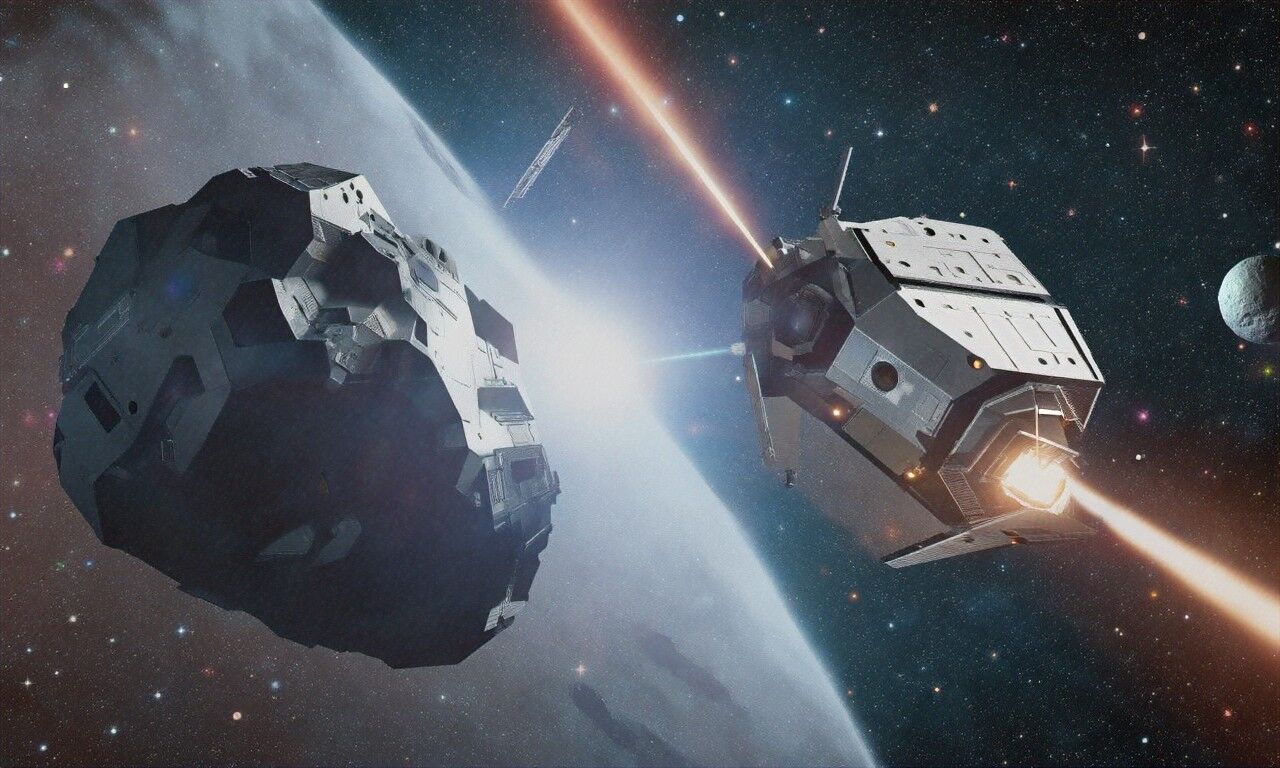
There’s an asteroid called 16 Psyche estimated to contain roughly $10,000 quadrillion worth of iron, nickel, and gold. That number is so large it basically stops meaning anything, it’s more than the entire global economy multiplied by about a hundred thousand. NASA launched a spacecraft to study it in 2023, not to mine it, just to look. But private companies aren’t content with just looking. At least four startups are developing extraction technology, two have test missions scheduled before 2030, and the legal framework for who owns what in space is being written right now.
And yet for the longest time, nobody took asteroid mining seriously. It showed up in novels, in the margins of conference slide decks, in the daydreams of planetary scientists after their third coffee. Engineers would nod and say “yeah, technically possible,” then immediately follow up with all the reasons it’d never happen: too expensive to launch, too hard to get there, too uncertain what you’d find. A fun intellectual exercise that stayed safely theoretical for decades.
That’s shifted. Not because physics changed (it didn’t), but because SpaceX and others drove launch costs down by roughly an order of magnitude, spacecraft got dramatically smaller and smarter, and a handful of companies decided to stop talking and start building actual hardware. I think we’ve crossed a line where asteroid mining isn’t really an “if” question anymore. It’s “when” and “who gets there first.”
What’s Actually Out There
Between Mars and Jupiter, millions of rocky and metallic objects orbit the Sun in what we call the asteroid belt. But the ones that matter most for early mining aren’t out there; they’re much closer. Near-Earth asteroids, the ones whose orbits swing them within relative proximity of our planet, number around 35,000 that we know about. New ones get spotted every week. Some of them, energy-wise, are actually easier to reach than the lunar surface. That’s a detail people often miss.
Asteroids break down into three broad types, and the type determines everything about how you’d mine them. C-type asteroids (carbonaceous) are the most common, maybe 75% of all known asteroids. They’re loaded with water, carbon compounds, organic molecules. Now, water in space isn’t valuable because anybody’s thirsty. Split water into hydrogen and oxygen and you’ve got rocket propellant. A water-rich asteroid parked near Earth could function as a gas station for deep-space missions, which is arguably worth more than any precious metal you could dig out of a rock. S-type asteroids (siliceous) come in second, silicate minerals, some nickel and iron. Decent, but not the headline grabber.
M-type asteroids are the headline grabber. These are thought to be the exposed cores of ancient protoplanets, bodies that had their outer rocky layers blasted away by collisions billions of years ago, leaving behind a dense metallic heart. Platinum, palladium, rhodium, iridium, osmium, ruthenium. On Earth, those metals are rare because they sank toward the planet’s core while everything was still molten during formation. What we mine today comes from geological flukes that pushed tiny amounts back up to the crust. On a metallic asteroid? They never separated out. They’re just.. there. Mixed in with iron and nickel, distributed through the whole body. Sitting. Waiting.
The Psyche Mission: Visiting a Metal World
NASA launched the Psyche spacecraft in October 2023, and it’s currently on its way to 16 Psyche with an expected arrival in August 2029. This isn’t a mining trip — it’s pure science. But the data coming back will matter enormously to anyone planning to pull resources from metallic asteroids down the line.
Psyche is big. Roughly 226 kilometers across at its widest, making it one of the largest objects in the belt. Early radar and infrared readings made it look like it was almost entirely metal: a bare planetary core just floating out there. More recent work has muddied that picture a bit. Its density is lower than you’d expect for a solid iron-nickel mass, suggesting it might be more porous than originally assumed, or there’s a significant fraction of silicate rock mixed in. But even a partially metallic Psyche would hold more iron, nickel, and platinum group metals than humanity has extracted in our entire history on this planet. Let that sit for a second.
Onboard instruments include a multispectral imager, a gamma-ray and neutron spectrometer, and a magnetometer. Together they’ll map composition, internal structure, and whether there’s a remnant magnetic field. That magnetic field question is fascinating on its own, if Psyche was once a planetary core, it may have generated a dynamo, and traces of that ancient field might still be detectable. From a mining perspective, though, the composition and structural data are what count. You can’t plan an extraction operation without knowing exactly what you’re cutting into and how it’s held together.
AstroForge: The Startup Chasing Platinum
Founded in 2022, AstroForge is probably the most visible company in the current wave of asteroid mining ventures. Their pitch is refreshingly narrow: find platinum group metals on near-Earth asteroids, extract them, bring them back, sell them. No sweeping visions about orbital cities or Mars colonies. Just platinum. Get it, sell it, repeat.
They’re using small, purpose-built spacecraft instead of anything resembling the massive crewed vessels science fiction promised us. Their first mission, Odin, flew in April 2023 as a rideshare on a SpaceX Falcon 9. It was a tech demo, a small satellite testing their metal refining process in microgravity, using a chunk of asteroid-like material brought up from Earth. The core idea is to refine ore in space, throw away the waste rock up there, and only bring back concentrated metal. That cuts the return mass dramatically, which cuts cost dramatically. Elegant, if they can make it work at scale.
Brokkr-2, their second mission, aimed higher: a flyby of an actual near-Earth asteroid to assess its composition remotely with onboard sensors. Details on results have been sparse, but the trajectory is obvious. Demonstrate technology. Pick a target. Send a scout. Then send the miners. They’ve raised serious venture capital from investors who seem to believe the timeline, uncertain as it is, is short enough to justify the risk.
And the platinum economics do make sense on paper. It trades at roughly $30,000 to $35,000 per kilogram on Earth right now. A smallish asteroid, maybe 30 meters across, of the right composition could hold platinum group metals worth billions. You don’t need to crack open an entire asteroid. Find a small, reachable one with the right stuff, pull out a few tons of high-value metal, get it home. That’s the entire business model in three sentences.
TransAstra: Water as the First Space Commodity
AstroForge wants platinum. TransAstra Corporation wants water. Founded by Joel Sercel, a former engineer at NASA’s Jet Propulsion Laboratory, the company is betting that the first real commodity traded in space won’t be some exotic metal, it’ll be plain old H2O, converted into propellant.
Their approach is called Optical Mining, and it’s kind of brilliant in its simplicity. You take large, lightweight inflatable reflectors and use them to concentrate sunlight onto the surface of an asteroid. Intense heat vaporizes water ice and volatile compounds trapped inside the rock. Capture the resulting gas in an inflatable containment bag. No drilling. No excavation rigs. No moving parts grinding against a tumbling rock in microgravity. Just sunlight and time. They’ve tested components in ground labs and simulated space conditions, and the basic physics works, concentrated solar energy does liberate water and volatiles from asteroid-like materials.
Picture what this enables if it scales up. Right now, the single most expensive part of any space mission is hauling mass off Earth’s surface. It costs thousands of dollars per kilogram just to reach low Earth orbit. Every drop of fuel you burn going to Mars is fuel you had to launch from the ground first, fighting through Earth’s gravity the whole way. But drop a water-fueled depot at a convenient orbital waypoint, stocked with propellant made from asteroid ice, and suddenly spacecraft can launch lighter, carry more useful payload, and go farther on the same budget. It’s the difference between driving cross-country with every gallon of gas packed in your trunk versus stopping at stations along the highway. That analogy is imperfect, but it captures something real about how space economics would shift.
Platinum Group Metals: Why They’re Worth the Trip
You might reasonably ask, and I think a lot of people do) why bother going to space for metals when we’ve got mines right here? Fair question. The answer has several layers, and they stack on top of each other in ways that I think make the case stronger than any single argument would.
Those six elements (platinum, palladium, rhodium, iridium, osmium, ruthenium, aren’t luxury goods. They’re industrial necessities woven into modern technology at a level most people don’t realize. Platinum and palladium go into catalytic converters, reducing harmful emissions from vehicles. Platinum is also a key material in hydrogen fuel cells, which are becoming increasingly important for clean energy. Rhodium, the priciest of the bunch (it’s traded above $500,000 per kilogram in recent years), is irreplaceable in certain catalytic applications: there’s no good substitute. Iridium shows up in spark plugs, crystal-growing crucibles, and as a hardening agent in alloys. These materials keep entire industries running.
And supply is getting tighter. Most of the world’s platinum comes from just two countries: South Africa and Russia. Those supply chains are fragile and tangled up in geopolitics. The mining itself is deep underground, energy-hungry, and produces staggering amounts of waste. Here’s a number that always gets me: the average platinum mine processes about six tons of ore to yield a single gram of platinum. Six tons for one gram. Margins are razor-thin even at current prices, and the environmental toll is massive.
On an M-type asteroid, platinum group metals could exist at concentrations hundreds or even thousands of times higher than anything in terrestrial deposits. No thin seams buried deep underground. No overburden to strip. No toxic tailings ponds. No communities displaced. The environmental impact on Earth would be, from a practical standpoint, zero. Engineering challenges? Enormous, yes. But the resource economics point so strongly in favor of space-sourced materials that it seems like the difficulties are a question of “how” rather than “whether.”
The Legal Framework: Who Owns an Asteroid?
Before anybody can sell so much as a gram of asteroid metal, there’s a legal tangle that needs sorting. And right now, it’s only partly sorted.
Everything starts with the 1967 Outer Space Treaty, ratified by over 110 countries including the US, Russia, and China. It says outer space and celestial bodies aren’t subject to “national appropriation by claim of sovereignty.” No country can own the Moon or an asteroid or anything else up there. But, and this is where it gets interesting, the treaty doesn’t clearly address whether a private company can own resources it extracts from a body nobody owns. That gap has been the subject of intense legal debate for years.
The US moved first. In 2015, Congress passed the Commercial Space Launch Competitiveness Act, which straightforwardly grants American citizens the right to own, transport, use, and sell resources obtained from asteroids and other celestial bodies. It’s careful not to claim sovereignty over any asteroid, just says if a US company digs something out, that something belongs to them. Luxembourg passed similar legislation in 2017. The UAE followed in 2020. A pattern was forming.
Not everyone’s on board, though. Some legal scholars and some nations argue the Outer Space Treaty’s ban on national appropriation extends to resource extraction — you can’t own pieces of something nobody can own. The Moon Agreement of 1979 tried to set up a framework treating space resources as the “common heritage of mankind,” but no major space-faring nation ever signed it. It’s mostly been ignored.
Then came the Artemis Accords, introduced by NASA in 2020, now signed by dozens of countries. They support the idea that extracting space resources doesn’t count as national appropriation, and that such activities should comply with the Outer Space Treaty. But they’re not a binding treaty; they’re bilateral agreements. And major players like China and Russia haven’t signed.
This ambiguity is a real problem, not a theoretical one. Companies like AstroForge and TransAstra are building business plans that assume US law will protect their property rights to whatever they pull out of an asteroid. Probably a safe assumption for now. But imagine a future dispute, a US company and a Chinese state enterprise both claiming mining rights to the same rock, millions of kilometers from any courthouse. That’s genuinely uncharted legal territory, and it could get messy in ways nobody’s fully anticipated.
The Engineering Challenges That Remain
I don’t want to make this sound easy. It’s not. And I think anyone who waves away the engineering difficulties is selling something. Let me walk through what still needs solving, because it’s a lot.
Getting there is hard. Even the closest near-Earth asteroids require months or years of transit. Your spacecraft needs enough fuel for the trip (or a way to refuel along the way, which loops right back to the water-propellant idea). Asteroids are small, weirdly shaped, and tumbling through space. Rendezvousing with a spinning rock maybe a few hundred meters across, millions of kilometers from Earth, with a minutes-long communications delay? That demands a level of precision that still pushes the boundaries of what autonomous navigation systems can do.
Anchoring is maybe even harder. An asteroid 500 meters wide has surface gravity roughly one hundred-thousandth of Earth’s. You can’t stand on it. Tools float away. Extracted material drifts off. And here’s the part that messes with your intuition: any mechanical process that pushes against the surface, drilling, scraping, digging) pushes the spacecraft away with equal force. Newton’s third law doesn’t care about your business plan. Every technique we use for mining on Earth relies on gravity holding everything in place. In space, you have to rethink all of it from scratch.
Processing in microgravity is largely unsolved at any meaningful scale. Terrestrial refining relies heavily on gravity: heavier stuff sinks, lighter stuff rises, and you separate them that way. None of that works when there’s no “down.” AstroForge’s in-space refining concept is one potential path forward. Magnetic separation for metallic ores is another. Solar furnaces that melt and sort material are being researched. But these remain experimental. Nobody’s demonstrated industrial-scale ore processing in space. Not even close.
And then there’s the return trip. Getting refined material back to Earth (or to an orbital facility where it can be used) needs either a dedicated return vehicle or some creative delivery mechanism. One idea: package concentrated metal into aerodynamic capsules designed to survive atmospheric re-entry and splash down for recovery. Another: deliver material to a space station or orbital depot for in-space manufacturing. Each option carries its own engineering requirements and risk. Neither is simple.
The Timeline: When Will It Actually Happen?
If there’s one thing I’ve learned from following this space, it’s that asteroid mining timeline predictions have a terrible track record. Terrible. Planetary Resources launched in 2012 with backing from Larry Page, Eric Schmidt, and James Cameron, real money, real names. They promised prospecting missions within a decade. By 2018, they’d run out of funding and got acquired by a blockchain company. Deep Space Industries, another early mover, was scooped up by Bradford Space in 2019. The first wave of asteroid mining startups hit economic reality and shattered.
The current crop (AstroForge, TransAstra, and a few others, learned from those crashes. Smaller first steps. More focused missions. More honest timelines. AstroForge’s incremental approach (demonstrate tech, then prospect, then extract) is designed to generate useful data and attract continued investment at each stage instead of gambling everything on one moonshot mission. That’s a completely, sorry, that’s a very different strategy than what Planetary Resources tried.
If I had to guess at a realistic timeline (and I could be wrong about all of this), it might look roughly like: prospecting missions identifying good targets within three to five years from now. Small-scale extraction tests on actual asteroids within five to eight years. First commercial-scale operations maybe by the mid-2030s. First significant quantities of asteroid material reaching Earth or being used in space within fifteen to twenty years. These estimates assume launch costs keep dropping, technology demos succeed, investment holds steady, and no major regulatory roadblocks pop up. Any of those assumptions could break. But the overall direction seems right, and momentum is building rather than fading.
What Asteroid Mining Could Change
If this works at scale, and I’m cautiously optimistic it will, eventually, the ripple effects go way beyond the mining companies themselves.
Start with the platinum market. Global annual platinum production sits around 180 tons. Now picture a company returning ten tons from a single asteroid mission. That kind of supply shock could crash the price, which sounds bad for the company doing the mining but would be enormously good for every industry that uses the stuff. Cheaper hydrogen fuel cells. Cheaper catalytic converters. Cheaper electronics. Those cost reductions cascade through the global economy in ways that are hard to fully map out but almost certainly positive for consumers and manufacturers both. (There’s probably a smart financial instrument that lets the mining company hedge against the price collapse they’d be causing, but that’s someone else’s problem to figure out.)
Think about the geopolitical angle too. Right now, a small number of countries control global supplies of materials that modern civilization depends on. Cobalt comes mostly from the Democratic Republic of Congo. Rare earth elements, mostly from China. Platinum, mostly from South Africa and Russia. Asteroid mining could rearrange those dependencies in deep and unpredictable ways, reducing the power that comes from sitting on top of a scarce resource. Some nations would find that threatening. Others would find it liberating. Either way, it’d reshape the board.
And then there’s what it means for space itself. If asteroid water can be turned into propellant and sold in orbit, the cost of doing anything in space drops sharply. Building stations, establishing lunar bases, sending crews to Mars, constructing solar power satellites, all of those become more affordable when you’re not hauling every kilogram from Earth’s surface. A space economy that can feed itself, rather than depending entirely on ground-launched supplies, is a space economy that can actually grow. That bootstrapping effect is, from what I’ve seen, the thing that gets space industry veterans most excited. Not the platinum. Not the money. The self-sustaining part.
Asteroid mining isn’t just about pulling rocks out of space and selling them. It’s about breaking the bottleneck that has constrained human activity in space since the beginning: the tyranny of lifting everything we need out of Earth’s gravity well. Once that bottleneck breaks, everything changes.
We’re still early. These companies could fail. Technology could stall. Maybe the spreadsheets are lying and the economics don’t pencil out. All possible.
But I keep coming back to something a friend of mine told me a few years ago. She’s an aerospace engineer, works on propulsion systems, and she’d just come back from a conference where AstroForge presented their refining demo results. I asked her if she thought any of this would actually happen in our lifetime. She was quiet for a second, then said: “When I started in this field, reusable rockets were a joke. People laughed at SpaceX. Now Falcon 9 lands itself on a barge in the ocean and nobody even watches the livestream anymore. It got boring because it worked.” She took a sip of her coffee. “Asteroid mining is going to be boring someday too. That’s how you’ll know it worked.” I think about that a lot.


(0) Comments