Fusion energy has been thirty years away for the last sixty years. That’s the joke, and it used to be accurate. Between 2022 and 2025, three separate experiments hit scientific breakeven, more energy out than what the lasers or magnets put in. Private companies raised over $7 billion. The ITER reactor in France, despite being roughly eleven years behind schedule and four times over budget, is actually assembling now. Something shifted, and I wanted to figure out exactly what.
That moment deserves a closer look, though, because it’s easy to misread. A Q factor of roughly 1.5, meaning the reaction produced about 50% more energy than the lasers delivered, sounds impressive, and it is. Scientific ignition, physicists call it. First time ever on Earth that a controlled fusion reaction beat the energy input. But those 192 lasers? They pulled something like 300 megajoules off the electrical grid to generate their 2.05 megajoules of light. So the fusion burn itself was net-positive. The whole system, from wall plug to fusion output, was wildly net-negative. Not even in the same zip code as break-even. Engineers sometimes describe this gap using “wall-plug efficiency,” and for NIF it was, to put it gently, grim. Still, and I think this point gets lost in the breathless headlines and the cynical backlash) that wasn’t what the experiment was trying to prove. The question was whether the physics works at all. Whether deuterium-tritium fuel, compressed and heated under the right conditions, would ignite and give back more than it took. It did. Everything after that is an engineering problem. And engineering problems, given enough time and money and clever people, tend to get solved.
To appreciate why this took so long, you’ve got to understand just how hostile the inside of a fusion reactor really is. We’re talking about heating fuel to at least 100 million degrees Celsius. At that temperature, atoms move fast enough that when two nuclei collide, the strong nuclear force overwhelms electrostatic repulsion and they merge (fuse, into helium-4, kicking out a high-energy neutron that carries about 80% of the reaction’s energy. Capturing those neutrons is how you’d eventually make electricity. Sounds clean. Sounds almost elegant. But the fuel at those temperatures isn’t a gas anymore. It’s a plasma, a churning storm of stripped electrons and bare nuclei that behaves like nothing else in nature. Plasma physicists sometimes call it the fourth state of matter, and they’re not being dramatic — it follows its own rules. Instabilities bloom in milliseconds. Edge-localized modes, called ELMs, can dump huge bursts of energy onto containment walls, chewing through material over time. Magnetic confinement configurations need to be tuned with almost absurd precision, and real-time feedback systems have to react faster than the plasma can misbehave. Which, from what I’ve seen, is very fast.
Then there’s tritium. You can’t just buy tritium at a hardware store. It’s radioactive, half-life of about 12.3 years, and nature doesn’t produce it in useful amounts. A working fusion plant would need to breed its own supply by wrapping the plasma in a lithium “blanket”, neutrons from the fusion reaction hit lithium atoms and transmute them into tritium and helium. Nobody’s done this at scale yet. ITER plans to test breeding blanket modules, but a commercial reactor would need a tritium breeding ratio above 1.0, meaning it makes more tritium than it burns. That’s probably achievable. Probably. Not guaranteed. And on top of all that, the neutrons flying out of a deuterium-tritium reaction carry 14.1 MeV of energy each, which over years of bombardment turns structural steel brittle and radioactive. Researchers are testing specialized steels, silicon carbide composites, tungsten alloys. No perfect answer yet. Maybe there isn’t one perfect answer: maybe it’s a combination of materials tailored to different parts of the reactor. Hard to say right now.
Two Paths, One Goal, and a Crowded Field of Newcomers
From the early 1950s, scientists chased fusion through two broad strategies. One: magnetic confinement, where powerful magnets hold superheated plasma in a doughnut-shaped vacuum chamber called a tokamak. Two: inertial confinement, where blasts of energy, usually lasers, crush tiny fuel pellets so fast that fusion happens before the material can scatter. NIF took the second path. The sun, of course, does it a third way entirely, using the gravitational pressure of 330,000 Earths’ worth of mass. We don’t have that option.
Both approaches spent decades making slow, grinding progress. Tokamaks got bigger and hotter. Laser arrays got more powerful. But plasma kept finding ways to escape its cage, writhing, twisting, touching walls it shouldn’t touch. Fuel pellets needed almost perfect symmetry in their compression, or the implosion fizzled. Each solved problem spawned two new ones. Funding agencies got impatient. Politicians asked whether the money might be better spent elsewhere. And the “thirty years away” joke calcified from wry humor into bitter resignation. I think what shifted in the 2010s was less a single breakthrough than an accumulation, better computational models, improved manufacturing, and a new class of superconducting magnets that quietly changed the math on what was possible.
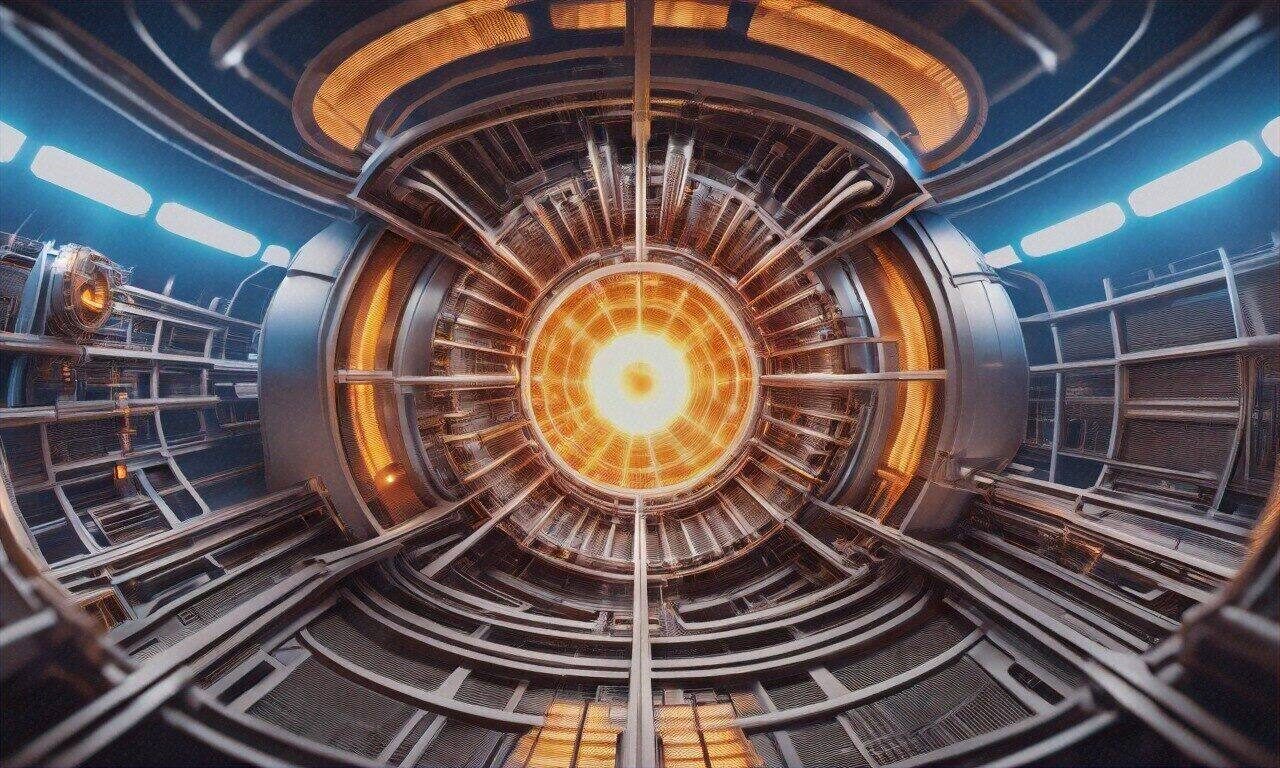
While NIF was working toward its December 2022 result, the biggest fusion project on the planet was taking shape in southern France. ITER, once short for International Thermonuclear Experimental Reactor, now they just call it ITER, which is Latin for “the way”) involves 35 nations and a budget that’s swollen past $22 billion. First plasma is expected around 2025 or 2026, though the timeline has a habit of slipping depending on who you ask. It’s a tokamak, and it’s massive: 30 meters across at the plasma chamber. Designed to produce 500 megawatts of fusion power from 50 megawatts of input heat, a Q factor of 10. For context, the previous tokamak record belongs to the Joint European Torus in the UK, which managed 59 megajoules over five seconds in February 2022, a Q of about 0.33. ITER aims to sustain reactions for minutes, not seconds, at temperatures exceeding 150 million degrees Celsius. Roughly ten times hotter than the center of the sun.
I walked the ITER construction site in 2023. Standing at the edge of that excavation (football fields wide, cranes lowering hundred-ton components into place with millimeter tolerance, you feel something between awe and vertigo. Director-General Pietro Barabaschi showed me through the assembly hall where vacuum vessel sectors were being prepared. “Every weld, every alignment, every measurement has to be right,” he said. “There’s no room for approximation when you’re building a sun.” Critics point to the cost overruns. They’re right, the overruns are real and significant. Some physicists argue tokamaks are simply too big and expensive for commercial power generation. But ITER’s purpose isn’t to be a power plant. It’s meant to answer questions about burning plasma physics that can’t be answered smaller or cheaper. The knowledge flows downstream into everything that follows.
And what follows might not look like ITER at all. The most unexpected twist in fusion’s story over the past five years has been private money, a lot of it, flooding into a field that used to belong entirely to government labs. Commonwealth Fusion Systems, an MIT spinoff founded in 2018, has raised over $2 billion from backers including Bill Gates and Google. Their bet is on a compact tokamak called SPARC that uses high-temperature superconducting magnets built from REBCO: rare-earth barium copper oxide. These magnets generate fields roughly twice as strong as ITER’s, which means you can shrink the machine dramatically. In September 2021, Commonwealth tested a large-bore HTS magnet at 20 tesla, the most powerful of its type ever built. Co-founder Dennis Whyte, who runs MIT’s Plasma Science and Fusion Center, told me it was the single biggest milestone on their road to a reactor. “The magnet is the enabling technology,” he said. “Once you have that, everything else follows.” SPARC targets a Q above 2, and the follow-on, a commercial pilot called ARC) aims to put fusion electricity on the grid.
They’re far from alone in this race. TAE Technologies in California has raised over $1.2 billion and is working with field-reversed configuration plasmas. Helion Energy, backed by Sam Altman, has pulled in north of $570 million and claims a working power plant by 2028, ambitious, to put it mildly. General Fusion in Canada is building a demonstration plant in the UK using magnetized target fusion. Zap Energy is exploring sheared-flow-stabilized Z-pinch plasmas. Germany’s Focused Energy is developing a commercial laser-driven system. The Fusion Industry Association counts more than 40 private companies worldwide now, with total investment past $6 billion. Even stellarators, an older magnetic confinement design that uses twisted field geometries instead of the tokamak’s induced plasma current, are getting a second look. Germany’s Wendelstein 7-X has posted strong plasma confinement results, and some researchers believe stellarators could be better suited for the continuous operation a power plant needs. The diversity might seem scattered or wasteful. I’d argue it’s the opposite. Nobody knows which approach will prove cheapest and most practical at scale. Running many experiments in parallel is a portfolio strategy, and for a problem this large, it seems like the right call.
Where Fusion Sits in the Energy Transition; and Why the Mood Has Changed
Here’s where things get complicated, because the question of whether fusion matters for climate change isn’t as straightforward as you might expect. The IPCC says global emissions need to drop by roughly 45% from 2010 levels by 2030 to hold warming to 1.5 degrees Celsius. Even the sunniest fusion timelines don’t put commercial plants on the grid before the mid-2030s, and a more sober estimate pushes into the 2040s or 2050s. By then, we’ll either have bent the emissions curve with solar, wind, batteries, and fission, or we won’t have bent it. Fusion, from this angle, looks like an answer arriving after the exam is over.
But I think that framing misses something. Maybe it misses a lot. The world’s electricity demand isn’t going to peak and flatten; it’s going to keep climbing as developing nations industrialize, as transportation electrifies, and as AI data centers devour staggering amounts of power. Solar and wind are wonderful. Batteries are getting cheaper fast. But baseload generation (reliable, round-the-clock power that doesn’t depend on weather or daylight, remains a gap that’s hard to fill without nuclear of some kind. Fusion, if it works at commercial scale, could be that source: hundreds of megawatts or gigawatts per plant, no greenhouse gas emissions, no long-lived radioactive waste, no meltdown risk, and fuel pulled from seawater and lithium deposits that are, for all practical purposes, inexhaustible. Deuterium from seawater alone could power civilization for millions of years. It won’t save us from the crisis of the 2020s and 2030s. We need to deploy what we already have for that — as fast as humanly possible. But fusion could be the technology that carries the second half of this century, and possibly every century after it.
There’s a geopolitical angle too, one that probably doesn’t get the attention it deserves. Right now, the global energy order is dictated by where fossil fuels happen to sit underground. Countries with oil and gas wield outsized power; countries without them are stuck importing, vulnerable to supply shocks and price manipulation. Fusion would blow that dynamic apart. Any nation with a coastline, essentially every nation, would have access to fuel. Tammy Ma, who leads the inertial fusion energy initiative at Lawrence Livermore, described it to me as “the great equalizer.” Energy independence as a function of physics and engineering, not geology. That’s a profound shift, if it happens.
What strikes me most, after three years of interviewing fusion scientists across four continents, is the change in tone. A decade ago, senior researchers were cautiously gloomy. They’d watched too many promising results fail to replicate. They’d grown tired of justifying another decade of funding to skeptical politicians. Today, that gloom has largely lifted, not because every problem is solved (it isn’t), but because progress has accelerated in ways that caught even insiders off guard. Anne White, a plasma physicist at MIT, told me: “We’re not waiting for a miracle anymore. We know the physics. We have the magnets. Now it’s about engineering execution.” I’ve heard some version of that sentence from researchers at national labs, universities, and startups on three continents. The question isn’t “can it work?” anymore. It’s “how do we make it work, and how fast?”
There’s a generational dimension to this, too. Younger scientists are gravitating toward private fusion companies, where things move faster and there’s less bureaucratic overhead. Some of the sharpest plasma physicists I’ve met are in their late twenties, working eighty-hour weeks at places like Commonwealth or Helion. They bring fresh thinking and a willingness to challenge assumptions that had gone unquestioned for decades. And many of them are driven by something deeper than curiosity: they see fusion as a plausible answer to climate change, and they feel that urgency in a way that earlier generations, through no fault of their own, maybe didn’t.
Mark Herrmann, who leads NIF’s weapons physics division, said something to me that I keep coming back to: “We’ve moved from asking ‘can it work?’ to asking ‘how do we make it work?’ Those are very different questions.” He’s right. And the difference between those two questions is the difference between speculative science and applied engineering. Between hoping and building. The convergence we’re seeing right now. NIF’s proof of concept, ITER’s march toward first plasma, billions in private investment, breakthrough magnet technology, a growing and motivated workforce, is unlike anything the field has experienced before. The money is real. The talent pipeline is healthier than it’s been in decades. Top physics and engineering graduates are choosing fusion over other careers, which by itself tells you something about where the momentum is.
I don’t want to oversell this. Not all forty-plus private fusion companies will survive. Some are burning through capital without a clear path to a working device. The history of energy startups is full of brilliant ideas that couldn’t scale, and fusion is brutally unforgiving of shortcuts. Regulatory frameworks for fusion plants haven’t been fully built out, licensing, safety standards, management and disposal of activated materials and tritium. These aren’t show-stoppers, but they’re real work that needs doing. And ITER’s construction delays are a reminder of how hard it is to build these machines on time and on budget, even with the backing of three dozen nations. Anyone who tells you fusion electricity is a certainty by a specific date is, I think, being more confident than the evidence warrants.
But something has changed. Not just the science and the money and the magnets — the feeling in the room when you talk to the people doing the work. It’s hard to quantify that, and I could be wrong about what it means. Still. For the first time in seventy years, the old joke about fusion being thirty years away feels like it’s losing its punch. Not because the timeline is settled, it isn’t) but because the questions being asked are different now. Better. More concrete. More solvable.
If you want to track this yourself, follow what happens with ITER’s first plasma experiments and Commonwealth’s SPARC device over the next two to three years. Those two milestones, more than any press release or funding announcement, will tell you whether the optimism is justified, or whether fusion still has surprises left to deliver.


(0) Comments