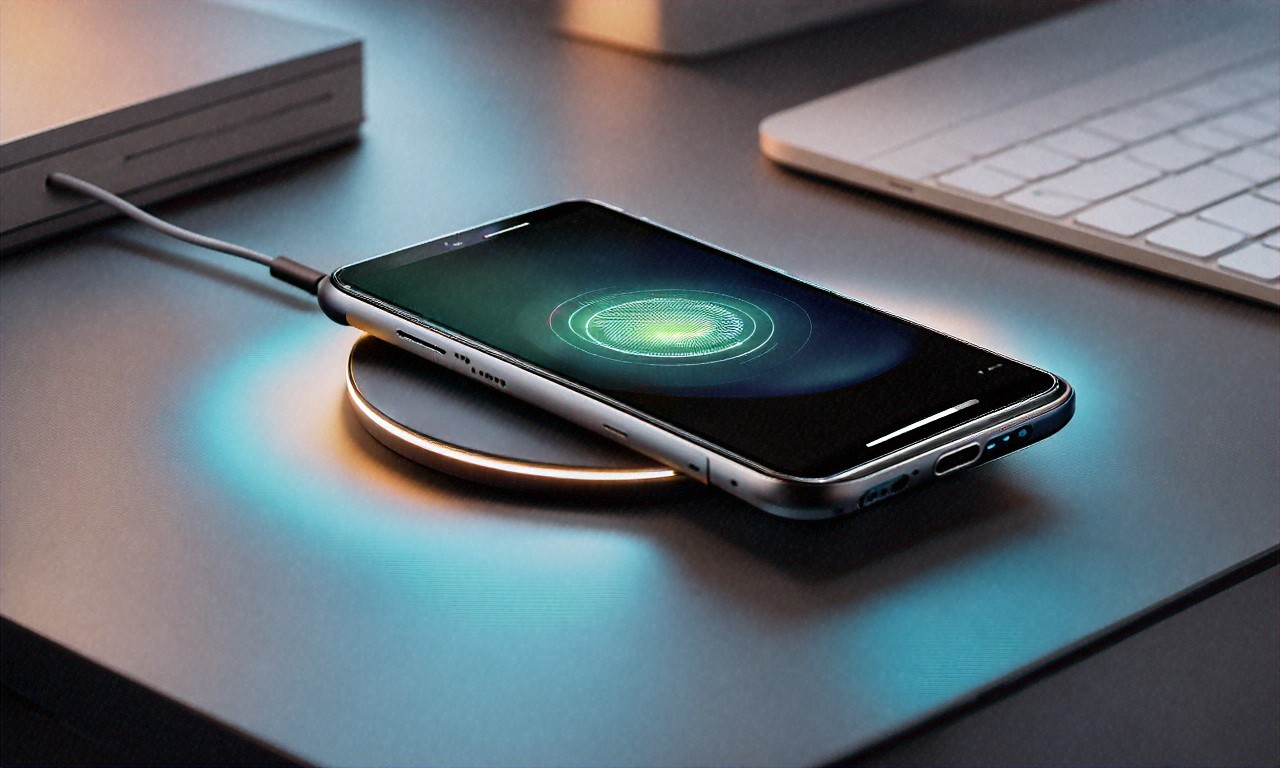
How wireless charging works through electromagnetic induction, where Qi2 stands now, and what over-the-air and EV charging might bring.
For years I told people to skip wireless charging. Then magnets proved me wrong.
Everyone repeats the same line. Cut the cable, join the future, stop tethering your phone to a wall like it’s 2009. And for a good stretch I said the exact opposite to anyone who asked. Don’t bother. I’d watched friends drop a phone onto a pad, wander off pleased with themselves, then come back an hour later to a device that hadn’t climbed a single percent. Two millimeters off-center was the whole story. The pad turned into an expensive coaster, and that person turned into someone who’d never give wireless charging a second chance.
So I quit recommending the things. Just use a cable, I’d say. Then the ground moved under me sometime in the last couple of years, and I keep chewing on why. Magnetic alignment showed up. Qi2 landed. What used to be a technology I’d written off got quietly, almost sneakily, good. Better than good, maybe. I’m still sorting out how I feel about that, granted, but the distance between wireless and wired has closed enough that I started paying attention again. Reluctantly, at first.
What I want to do here is walk through the actual mechanism, where the standards sit right now, and what’s coming. Parts of it get technical. I’ll keep my feet on the ground where I can.
The little slice of physics that powers every pad you’ve ever touched
Michael Faraday worked out the core idea in 1831, which is a humbling thing to type, because it means the thing on your nightstand runs on physics older than the lightbulb. Push alternating current through a coil of wire and a fluctuating magnetic field comes off it. Set a second coil nearby and that shifting field shoves current through it. That’s the trick, the entire trick. Every charger sold today, no exceptions I know of, comes back to this one sentence.
Your pad has a transmitter coil hooked to a power source. Inside the phone sits a receiver coil wired into its battery management circuitry. Set the phone down and the transmitter throws off an oscillating magnetic field (somewhere between 100 and 205 kHz on Qi devices), and the receiver coil turns it back into current. Clean enough in theory.
Practice gets sloppy fast. The coupling between two coils drops off hard the moment distance or offset creeps in. Picture two singers trying to hold a note in unison while one of them keeps drifting flat; the harmony only holds if they’re locked together, and the second they’re not, the sound goes thin and ugly. Magnetic fields behave with the same impatience. A small misalignment can drag efficiency from roughly 80% down to 50% or worse, and at some threshold the charger just gives up and stops pushing power at all. Which, again, was the exact failure I kept hitting a few years back.
Resonant charging, or the same physics wearing a better suit
Resonant charging keeps that induction mechanism and bolts something smart onto it. Both coils, transmitter and receiver, get tuned to the same resonant frequency. When two circuits ring at the same pitch, energy crosses between them with far less waste, even over a wider gap, even when the alignment isn’t perfect.
Here’s the way I think about it. Strike a tuning fork and set it near a second fork cut to the same note, and the second one starts humming on its own, no contact, just the matched frequency doing the work across open air. Hit a fork tuned to a different note and nothing happens, the energy has nowhere matched to go. Resonant charging pulls the same move electromagnetically. The two coils are tuned to each other, so power moves between them more willingly than raw induction ever manages.
In plain terms? Charging gaps of 40 to 50 millimeters where standard induction tops out around 7 to 10. A lot more slack on alignment. It’s likely why some of the newer multi-device mats charge a phone wherever you drop it on the surface; they’re built on resonant principles, usually stacked with overlapping coils, to open up a broader zone where charging actually happens.
None of which comes free
Resonant rigs are tougher to build. Precise tuning isn’t optional. They get jumpy around nearby metal, and a coin left between phone and pad can soak up magnetic energy and warm up, which is both an efficiency drain and a genuine safety worry. Foreign object detection handles this on modern chargers, but it piles on cost and complexity.
Standard induction, by contrast, is cheap and simple and thoroughly understood by now. For a nightstand where centering your phone takes no thought, it’s perfectly fine. When convenience carries more weight (car mounts, chargers sunk into a desk or a side table), resonant flexibility is probably the smarter pick. I won’t pretend that’s settled, since every setup pulls in a slightly different direction.
Qi, the standard that quietly won
The Wireless Power Consortium put out the Qi standard in 2008, and over time it grew into the dominant wireless charging protocol on the planet. Version one carried 5 watts. Achingly slow. Topping up took an age, efficiency loitered around 60 to 70%, and most people filed it under novelty rather than anything they’d actually rely on.
Then revisions arrived. The Extended Power Profile shoved things to 15 watts for phones, which pulled wireless charging times much nearer to what a cable gives you. Samsung parked at 15W. Chinese makers like Xiaomi and OnePlus went well past that with proprietary tweaks, 50W and sometimes more, running modified protocols that technically live outside the Qi spec.
But the wattage was never the whole story, maybe not even the part worth caring about most. Every revision sharpened the conversation running between charger and phone. A modern Qi device trades data packets constantly. They settle on a power level, keep an eye on temperature, and tune the output as conditions move. Battery warming up? The charger eases off. Everything looking healthy? It feeds more in. That back-and-forth intelligence is what keeps the whole thing efficient and safe at once, and honestly, I didn’t appreciate how much of it was happening until recently.
Qi2 and the magnets that quietly fixed the worst of it
Apple shipped MagSafe for iPhone in 2020. A ring of magnets circling the charging coil. The phone clicks into dead-center alignment with the pad every single time, no nudging, no glancing back, no returning to a flat battery. Sounds minor. Wasn’t.
The Wireless Power Consortium evidently saw it the same way, because in 2023 they released Qi2, which folds Apple’s Magnetic Power Profile into the open standard. Any maker can build on it. Pick up a Qi2-certified phone and it snaps onto any Qi2-certified charger with that same satisfying click. Samsung on a Belkin charger. Google Pixel on an Anker pad. Doesn’t matter whose logo is where. Magnets sort out coil alignment for you, dragging efficiency up into a steady 75 to 85% band. That’s a real leap from the old routine of crossing your fingers and hoping the phone landed somewhere useful.
Why alignment buys you more than convenience
Coils lined up perfectly means less energy thrown away. Waste like that turns into heat, so cutting it cools the whole exchange down. Run cooler and a charger can push higher wattage before thermals get scary. Qi2 opens at 15W, and the standard was drawn up to climb; there’s already chatter about 30W, then eventually 50W, which would shove wireless charging right alongside plenty of wired fast-charging setups.
An environmental thread runs through this too, and it’s worth a beat. Older Qi chargers sitting at 60 to 70% efficiency were dumping 30 to 40% of everything they drew from the wall, all of it bleeding off as heat. Qi2 nudges efficiency toward 80 to 85%. Spread that gain across a few hundred million devices charging every night and the energy you save starts to add up at a scale that actually means something. I doubt anyone’s run a precise global tally, but the direction reads clear enough.
MagSafe and a three-year head start
Apple had magnetic wireless charging out in the wild for three years before Qi2 caught up to the same approach. That lead matters, because MagSafe carries the most built-out accessory world of any magnetic phone system going. Wallets that latch on. Car mounts that grip with magnets instead of clamping arms. Battery packs, tripod mounts, a whole drawer of odds and ends.
MagSafe charges at 15W on a compatible iPhone, against 7.5W for plain Qi on that very same handset. Double the rate, purely from getting the alignment right. That one figure tells you how much energy used to evaporate when the coils sat even slightly off.
Now Qi2 cracks the same magnetic standard open to Android, so accessory makers can finally build gear that crosses both camps. Economies of scale ought to pull prices down and kick loose new designs. Qi2 car mounts, desk stands, and portable packs that work with phones from every big manufacturer are already turning up. From what I’ve seen, the shelf is filling out quickly.
The efficiency numbers, broken down honestly
Efficiency gets tossed around a lot in these conversations, but the figure that genuinely counts is wall-to-battery: how much of what leaves your outlet ends up parked in the phone. Every link in the chain leaks a little, and it pays to know where the leaks sit.
- Wall adapter (AC to DC conversion): a modern GaN charger pulls this off around 90 to 93%. Older bricks can run lower.
- DC to high-frequency AC for the transmitter coil: roughly 92 to 95%, riding on how well the charger was designed.
- Wireless transfer between coils: with the alignment dialed in (magnets help a lot here), about 85 to 90%. Without it? Could sag to 65% or worse.
- Phone-side voltage regulation and charging circuitry: another 5 to 8% goes here, turning into a touch of heat inside the phone itself.
- Total wall-to-battery for a well-aligned Qi2 setup: somewhere near 65 to 75%. Set that against wired charging at 85 to 92%.
Older non-magnetic Qi chargers with lazy alignment? Those could bottom out at 45 to 55% total. So Qi2’s magnets have roughly halved the efficiency penalty. Not flawless, but real progress, and given how grim things used to be, I’d happily call it a win.
Heat, which is the part nobody likes to bring up
Every scrap of lost efficiency comes back as heat. And heat quietly chews through lithium-ion batteries. Charge a battery at high temperature and the internal degradation speeds up, lithium plating inside the cells goes uneven, internal resistance creeps upward, and maximum capacity drifts down across months and years. Your phone won’t keel over one morning from heat. It just ages faster than it had any right to.
Wireless charging, by its nature, runs hotter than a cable because of those efficiency losses. The coupling between coils is never perfect, and whatever doesn’t make the jump turns into thermal energy on both ends. That’s why a half-decent wireless charger packs a little fan or a heat sink, and why your phone might feel warm after a stint on the pad.
Modern protocols are pretty sharp about riding herd on this. Charger and phone both watch temperature without letup and keep renegotiating power to stay inside safe limits. Too warm? Power eases. Far too warm? Charging pauses outright. You might catch your phone topping up quicker in an air-conditioned room than baking on a car dashboard in August, and that’s the thermal management earning its keep. A small detail on paper. Probably tacking years onto your battery’s working life in practice.
If you want to give it a hand: peel thick cases off before charging (they hold heat in like a wrapped scarf), pay up for a charger with active cooling when you’re regularly running higher wattage, and lean on overnight charging at lower power. Gentler on the cells. You’re asleep anyway, so where’s the rush.
Wireless charging is escaping the phone
Phones got the technology first, but they won’t keep it to themselves for long. Earbud cases have carried Qi for years. Smartwatches have run proprietary wireless charging since the start. What’s new is the technology pushing into much bigger territory.
Laptop wireless charging is inching toward the real world. The Qi laptop target aims at 65W or higher, which covers most ultrabooks. Engineering gets meaner at that level: larger coils, fussier thermal management, pricier electronics. Several makers have shown prototypes, though, and my hunch is commercial products land inside a year or two, sooner if somebody decides to get aggressive about it.
Electric vehicle charging is where my eyebrows actually go up. Companies are building pads you simply park over. No cable, no plug, no thought spent. These run at 7 to 11 kilowatts, plenty to fill most EVs overnight. Same physics as charging a phone, scaled up enormously. And the efficiency holds up better than you’d guess, around 90 to 93%, brushing right against what a wired connection delivers. Could be the bigger coils and tighter engineering at that size end up working in the technology’s favor.
Pads turning up in airports, cafes, even your IKEA side table
A trend I find genuinely fun is wireless charging seeping into public space. Airports. Coffee shops. Hotel lobbies. Conference rooms. Qi chargers sunk straight into the table surface. Sit down, drop your phone on the marked patch, and it charges. No begging for a cable, no rooting through a bag for the right adapter. Just power, sitting there in the furniture.
IKEA has sold wireless charging furniture for a while, and Qi2 should make it more practical still. With magnets steering the alignment, you don’t even need a precisely marked target; the phone finds its own spot. Sinking the coil into a surface gets cleaner, more invisible, harder to spot at all.
Restaurants and bars are clueing in too. Build charging into the tables and customers settle in longer. They order another drink, another small plate. Their phone’s filling up, so why head out? It’s a retention play dressed up as a courtesy. Clever, when you think about it. I’d bet we see a great deal more of this over the next few years.
Over-the-air power, the dream that’s still mostly a dream
True over-the-air charging, devices sipping power from open air with no pad, no placement, no contact at all, is probably the most thrilling thing on the horizon. Also the furthest off. A handful of companies are chasing focused RF energy beams that could charge a phone clear across a room. Walk in your front door, phone starts topping up in your pocket. That’s the sales pitch, anyway.
The physics holds, in principle. Engineering it, though, is brutal. Current prototypes hand over maybe 1 to 2 watts at a distance of a few meters. Enough to trickle a phone along, nowhere near enough for daily use. Regulatory questions loom large as well: beaming meaningful RF energy around a living room raises safety concerns that’ll demand careful, patient answers before any agency waves it through.
Infrared laser systems take a different road. Focused IR beams land on a small photovoltaic receiver stuck to the device, turning light into electricity. More power potential at range, but you need line-of-sight and serious tracking to keep the beam pointed right, with safety systems that kill the beam the instant anything crosses the path. Impressive work. Still not ready for your living room.
A realistic timeline? I’d guess five to ten years before beamed charging turns into a mainstream consumer product for phones. Maybe sooner for the low-power stuff, IoT sensors, earbuds, watches, since those devices ask for so little power that even today’s prototypes could feed them. But your phone? Hang onto the charging pad a while longer.
What’s actually worth buying right now
Shopping for a wireless charger in 2026, a few things carry more weight than the rest. Start by checking whether your phone does Qi2. If it does, buy Qi2. The magnetic alignment by itself justifies the upgrade, and I’d argue it’s the single biggest quality-of-life jump in this technology’s whole history, no exaggeration meant.
On output, 15W sits in the sweet spot for most phones. Reaching higher only pays off when your particular model genuinely supports faster wireless speeds. Otherwise you’re handing over money for watts the phone will never touch.
Form factor follows wherever you’re putting the thing. A stand keeps your screen up and visible, handy on a desk where you glance at notifications. Flat pads suit a nightstand, where you just set the phone down and drift off. Multi-device chargers cover phone, earbuds, watch, all in one go, which trims real cable clutter off a surface.
One thing people skip right past: the wall adapter. Plenty of wireless chargers ship without one, and feeding a 15W charger off a feeble 10W brick means you’ll never reach full speed. Grab a solid 25 to 30W USB-C adapter from Anker, Belkin, or Apple’s own GaN unit and you won’t get bottlenecked. Looks like a minor detail. It really isn’t.
Where I think this is all going, though I’m still working it out
Cables are sliding toward optional. Not gone, not yet, but less and less necessary for the daily chore of keeping your gadgets alive. Qi2’s magnetic alignment killed the frustration that made people (me very much included) wave wireless charging off. Efficiency gains have shut most of the gap with wired. And as charging melts into cars and furniture and airports, then one day into the air itself, the whole little ritual of “finding a charger” starts to feel like a relic from some earlier decade.
I’m genuinely not sure we’ll look back on charging pads as crude relics; they might simply go invisible, baked into every surface a hand touches. But if beamed power across a room ever truly matures, then sure, maybe pads end up filed next to the dial-up modem in the museum of things that worked and now seem quaint. Either way, if you haven’t tried wireless charging lately, the 2026 version bears almost no resemblance to what it was a few years back. Grab a Qi2 charger, feel that magnetic click land, and judge for yourself whether two millimeters still decides everything. (For what it’s worth: it doesn’t anymore.) I keep going back and forth on how much of my early skepticism was fair and how much was just bad luck with cheap pads, and I haven’t fully landed on an answer. Maybe I never will.
Wireless charging was never really about losing the cord. It’s about scraping the friction off one of the dullest, most repeated chores in a digital day. And friction, once it goes, tends to take our old habits with it.


(0) Comments