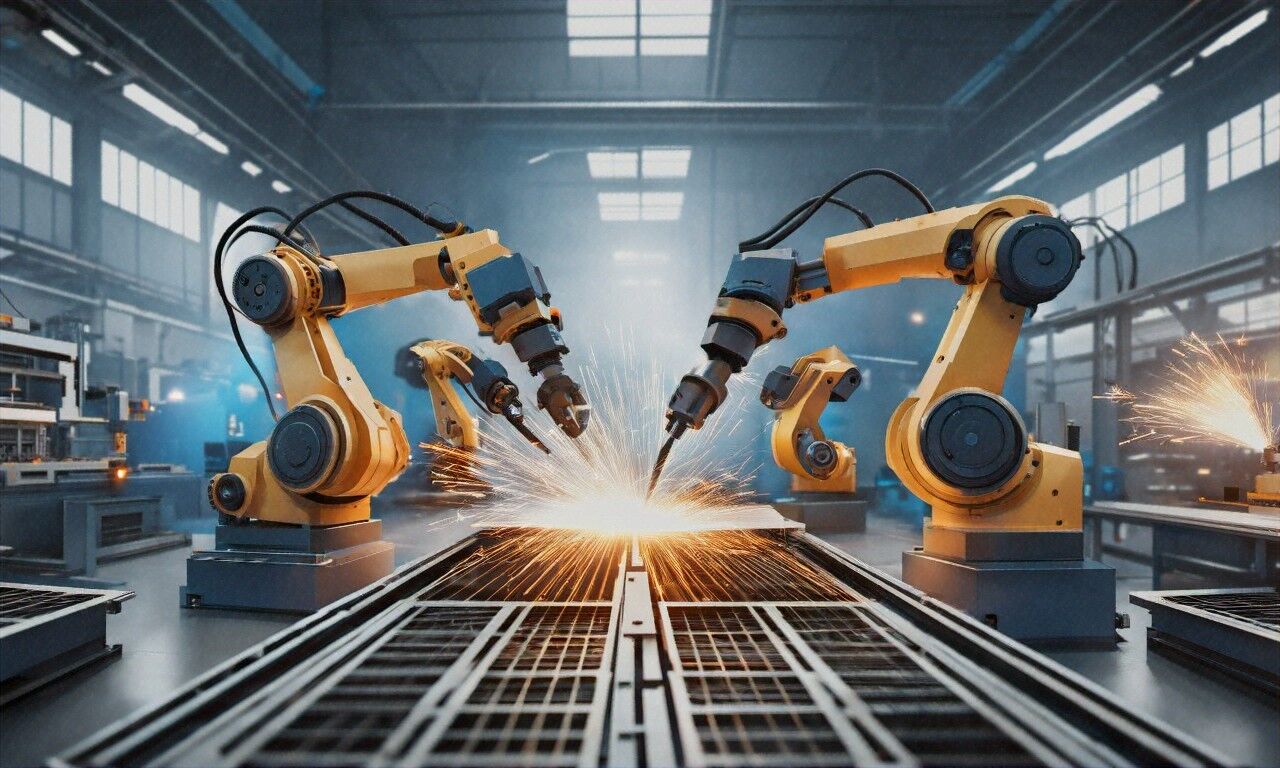
Factory robots stopped being dumb arms in cages. Now they see, they feel their way into contact, and they learn from what just happened. Here’s what that shift looks like on the floor, what the numbers say, and why the speed of it should worry us more than the machines themselves.
Picture a matte-white robotic arm on an automotive line. It swings a door panel into place, lays a bead of sealant along a seam, then pauses for a fraction of a second before the next part shows up. No clang of metal. The air tools that should be screaming stay silent. Just a low electric hum and a motion so smooth it reads as almost animal. Nearby, a cluster of smaller bots sorts fasteners the line fed them last week, part specs nobody ever programmed in by hand. They worked the rest out overnight. That scene isn’t science fiction, and it isn’t a vendor demo reel either. It’s a Tuesday on plenty of plant floors right now, and the quiet is the strangest part.
Factory robots have been around forever, and for most of that history they were, frankly, kind of stupid. The first one was the Unimate. It showed up at a General Motors plant in Ewing, New Jersey, back in 1961. A giant arm, basically. Its whole job was grabbing die castings off a line and welding them onto car bodies. One job, the same exact way, every single time. Change anything and a human had to rewrite its code line by line. That arrangement held for roughly fifty years. Powerful machines, sure, but rigid as a steel beam, penned inside cages because they’d crush whoever wandered too close. No awareness at all. If a part came in slightly crooked, the arm would try to jam it in anyway and wreck the part, sometimes itself. Intelligent isn’t the word I’d have reached for.
So what flipped? Probably not what most people assume. It wasn’t really the hardware. A robotic arm built today isn’t wildly different, physically, from one built twenty years ago. What changed is the brains, and they got scary good fast. Now you get computer vision, so the robot can see. You get force sensors, so it can feel its way into contact instead of slamming into it. And you get machine learning, so it adjusts on the fly rather than running the same frozen script until somebody reprograms it. Stack all that together and a glorified power tool turns into something that, I think, honestly earns the word “intelligent.”
An example that stuck with me. A plain welding robot fires the identical weld at the identical spot thousands of times a shift, zero variation. Path Robotics, out in Columbus, Ohio, builds welding systems that work differently. Cameras and machine learning look at each joint on its own. Gap in the seam? Settings shift. Piece a little warped? It compensates. A configuration it’s never seen gets matched against training data drawn from millions of prior welds. Their defect rate sits around 0.3 percent. Manual welding runs somewhere between 2 and 4 percent. Spread that gap across millions of welds a year and you’re looking at real money saved on rework and scrap and warranty claims. Not small potatoes.
What genuinely reshaped how people and machines share a floor was the cobot. The old setup meant strict separation. Robots in cages, humans outside, full stop, because mixing the two landed somebody in a hospital. Universal Robots, a Danish company, more or less invented the category when it shipped its first model in 2008. Sales have climbed hard since, hitting 2.1 billion dollars in 2025 according to the International Federation of Robotics. The appeal is that cobots are built to stand right next to you. Force-torque sensors catch unexpected contact and freeze the arm instantly. They move slowly enough not to hurt anyone. And the part that actually drives adoption is how easy they are to teach. Somebody with no coding background can grab the arm, walk it through the motions by hand, and the robot watches and repeats. That’s roughly a forty-minute job for something that used to need a contractor and a week.
I’ve seen this play out at smaller shops, and the worker reaction tends to follow the same arc. Fear first, because the obvious assumption is that the machine showed up to replace you. Then something closer to relief, once it’s clear the cobot is taking the parts of the job that wreck shoulders and backs over a decade. Repetitive lifting is exactly the kind of work that piles up injuries quietly until somebody needs surgery. Hand it to a machine and those complaints tend to drop off. For what it’s worth, that pattern shows up far more often than the wholesale-replacement story the headlines prefer.
Why the software, not the steel, is the real story
Reinforcement learning, the same technique DeepMind used when AlphaGo beat the world champion at Go, is now running inside factory robots. Rather than scripting every micro-movement, you tell the robot to pick this thing up and set it over there, then let it work out the how through trial and error. Thousands of attempts run in simulation, and the behavior that emerges gets transferred onto the physical machine. Covariant, a startup that came out of UC Berkeley, has shipped this for warehouse automation alongside companies like ABB and Knapp. Their robots pick and sort objects they’ve literally never encountered, oddly shaped packages, floppy bags of clothing, whatever, at reliability above 99 percent. That number still strikes me as a little absurd.
Computer vision for quality control has reached a point that’s, honestly, a bit humbling for us soft-eyed humans. Cognex, a machine-vision outfit based in Massachusetts, reported in its 2025 annual report that its AI inspection systems catch defects as small as 0.01 millimeters. Smaller than a human hair. A trained human inspector might catch the low-90s percent of defects on a sharp day. Machines don’t have sharp days and dull ones, though. They don’t get distracted at 3 a.m. They just look, every part, forever, and that flat consistency is most of the point.
Digital twins might be the sleeper development that nobody outside manufacturing talks about enough. Nvidia’s Omniverse platform and Siemens’ Xcelerator let a manufacturer build an exact virtual copy of an entire floor. Every robot, every conveyor, every workstation, modeled in real time. Engineers test new setups and rework layouts and train robot behaviors entirely in simulation before anyone touches a physical bolt. BMW has said it saved 10 million dollars during the Spartanburg plant’s last reconfiguration by running the whole thing through its digital twin first. Problems that would’ve meant weeks of downtime on the real floor got caught in the virtual one. It feels obvious in hindsight, though the tooling to do it well only showed up recently.
Scale gets lost when you stay at the level of individual stories, so here are some anchors. Global installations of industrial robots hit 590,000 units in 2025, up from 517,000 in 2023, per the International Federation of Robotics. China alone installed more than all of Europe and North America put together, 52 percent of global installations. South Korea leads the world on robot density at 1,012 robots per 10,000 manufacturing workers. Singapore sits at 770. Germany, 415. The United States, 295, which sounds tolerable until you notice China climbed from 68 per 10,000 workers in 2016 to 392 in 2025. A jump like that over nine years should probably make a few people uneasy.
On the money side, McKinsey estimated in a 2025 report that AI-powered automation could add 4.4 trillion dollars in value to global manufacturing by 2030. Value, not revenue. That figure folds in less waste, better quality, lower energy bills, faster time-to-market, and yes, reduced labor costs too. Deloitte ran a survey and found that manufacturers who’d deployed AI-powered robotics saw an average 22 percent bump in productivity and a 17 percent drop in defects inside the first two years. Those aren’t rounding-error gains. They’re the kind of numbers where a competitor who moved first quietly starts eating your lunch.
For a long stretch, only the big players could afford any of this. A traditional industrial robot installation might run 500,000 to a million dollars once you tallied the robot, the safety cage, the integration work, the custom programming, plus the specialized maintenance afterward. The 50-to-500-employee shops that form the backbone of American and European manufacturing simply couldn’t reach it. Too expensive, end of conversation.
That wall’s coming down fast, though. A Universal Robots cobot starts at roughly 25,000 dollars. Vention, based in Montreal, sells modular robotic work cells you configure online, then order, then bolt together on-site in days instead of months, starting around 50,000 dollars for a complete system. Rapid Robotics in San Francisco runs a robots-as-a-service model where you pay about 2,200 dollars a month and own nothing outright. In most of the United States that comes in at less than half the fully loaded cost of one human worker. I’ve watched the logic of this at a thirty-person family machine shop that put in two cobots to tend their CNC machines, partly because nobody local wanted to stand and load parts for eight hours. Output climbed something like a third inside six months, and the headcount didn’t drop by a single person. The people moved to work that actually needs a brain attached.
The uncomfortable question, and the parts nobody clicks on
Are robots taking jobs? Some, yes. The fuller picture is messier than the scary headlines let on. The World Economic Forum’s 2025 Future of Jobs Report estimated that automation and AI would displace 83 million jobs globally by 2030 while creating 69 million new ones. Net loss of 14 million. Sounds grim, maybe, until you weigh it as under half a percent of the global workforce, spread across five years, across every sector rather than manufacturing alone. Context tends to deflate the panic a little.
What shows up on actual floors looks less like elimination and more like a swap. The jobs robots absorb are mostly the ones humans actively don’t want. Repetitive material handling. Staring at identical parts through a whole shift. Working around extreme heat, or toxic fumes, or machinery that could take an arm off. The Bureau of Labor Statistics reports that manufacturing workplace injuries have fallen 31 percent since 2015, and a fair chunk of that traces back to robots soaking up the dangerous work. That’s not nothing, and it rarely makes the front page.
Meanwhile, roles keep appearing that didn’t exist five years back. Robot technicians. Automation coordinators. People who design how humans and machines interact. Analysts who make sense of the data pouring off a smart floor. Look at Amazon, which runs more than 750,000 robots across its fulfillment centers and employs more people now than it did before the robots arrived. Different jobs, though. Rather than dragging heavy bins across a warehouse, people manage robot fleets, troubleshoot the systems, and sort out the weird exceptions a machine can’t reason through. Community colleges have noticed; some now hand out certifications in robot programming and maintenance and systems work, with graduates fielding offers in the 55,000-to-70,000-dollar range before they even finish, which around a lot of the country beats a four-year degree. Good news about factory jobs just doesn’t generate clicks, which is annoying but true.
COVID taught everyone something blunt about supply chains, and robots are part of the response. When China’s factories went dark in early 2020, the shock rippled through manufacturing worldwide. Companies that had spent decades offshoring suddenly couldn’t get parts. The semiconductor shortage on its own cost the global auto industry an estimated 210 billion dollars in lost revenue in 2021. One disruption, 210 billion dollars, gone.
AI-powered robotics is making it financially realistic to bring production back home in a way it wasn’t before. Once labor shrinks as a share of total production cost, the upsides of building near your customers start to outweigh cheap overseas labor: shorter chains, lower shipping, quicker response when demand lurches. Intel’s new fab in Ohio, a 20 billion dollar investment announced in 2022, was designed from the ground up around automated systems. TSMC’s Arizona facility runs with roughly 30 percent fewer workers per unit of output than comparable plants in Taiwan, not because the people are sharper but because the robots carry more of the load. Boston Consulting Group estimated in 2025 that reshored U.S. manufacturing, helped along by advanced automation, could add 2.5 million jobs domestically by 2030. Not robot-operating jobs specifically. Jobs across the whole surrounding ecosystem: building facilities, maintaining gear, running supply chains and logistics, plus all the service work that sprouts around a manufacturing hub. When a Korean battery maker drops a 2.5 billion dollar automated plant into a small town, the plant itself might employ 1,200 people, and the restaurants and hotels and daycare centers that follow have nothing to do with robots at all.
A twist I didn’t expect when I started reading into this is the environmental angle. AI-powered robots come out noticeably easier on the planet than the processes they replace, and not only for the obvious reason. Sure, they waste less material because they’re more precise. Fanuc, the Japanese robotics giant, claims its latest AI-guided welding systems cut filler-material waste by 40 percent against manual welding. The bigger lever, though, is energy. Smart-factory systems where AI runs the whole production flow, not just one arm, can trim energy use by 15 to 25 percent, per a 2025 Fraunhofer Institute study. The software learns to push energy-hungry operations into off-peak hours, to power down idle equipment, to tune machine speeds for efficiency rather than raw throughput.
Schneider Electric’s factory in Lexington, Kentucky, tagged a “Lighthouse” smart factory by the World Economic Forum, cut its energy consumption 26 percent and its CO2 emissions 78 percent over five years through AI-driven optimization. And the kicker is that production rose 20 percent in the same stretch. Less energy, fewer emissions, more product off the line. Lay that equation in front of a boardroom and decisions get made fast. It’s happening across hundreds of facilities now, not a handful of showpieces.
So what does the factory of 2030 actually look like? From what I’ve seen and read, I’d sketch it roughly like this. Most repetitive physical work goes to robots. Cobots handle anything that needs close human collaboration. AI quietly runs scheduling, quality control, predictive maintenance, energy optimization, all of it in the background. Humans concentrate on creative problem-solving, on the exceptions, on customer-specific customization, on keeping an eye on the AI itself. A floor like that reads less like a traditional plant and more like a tech office that happens to have machines in it. Genuinely strange to picture if you’ve never stood inside one of these places.
Generative AI is poised to scramble things in ways we’re only starting to glimpse. Autodesk and Siemens are both building tools where an engineer describes a part in plain language, a bracket that holds 50 kilograms, fits a given space, prints in titanium, and the software returns optimized designs. Some look nothing like what a human would draw. Organic shapes. Asymmetric. Full of lattice and hollow sections that shave weight while holding strength. And they work. Airbus already used generative design for cabin partition components that came in 45 percent lighter than the traditional versions. The convergence of AI, robotics, additive manufacturing, digital twins, all of it together, is starting to blur the line between designing a thing and building it. You could describe a product, have AI design it, prove it in a digital twin, then let robots build it, with a human touching each step only lightly. We’re not fully there. Honestly, though, the gap is smaller than most people outside the industry would guess.
What worries me isn’t the technology. It’s how fast all of this is moving. Companies that adopt AI-powered robotics early are posting 20 to 30 percent productivity gains, and the ones that hang back are slipping behind. In a tight market, slipping behind means going under, and the towns built around those companies go down with them. The gap between countries is widening too. South Korea and Japan and Germany and China are pouring money into automation. Large parts of Africa, South America, and South Asia, regions that were counting on manufacturing as the ladder up that China climbed, may find the ladder pulled away before they reach it, because an automated factory simply needs fewer low-skilled hands. That isn’t a technology problem. Call it a policy problem, an education problem, a money problem, and bear in mind those three move far slower than the robots do.
The forward-looking bet I’d put real money on sits one industry over. That same vision-plus-learning stack that tightened a weld seam to 0.01 millimeters is already getting aimed at construction, where autonomous machines lay block overnight and robot framing crews are being tested against 48-hour house timelines. Watch which 2026 building permits start listing automated framing as a line item. That’s the signal that this stopped being a factory story and became a housing one, and the country that can’t build homes fast enough is exactly where the 0.3-percent defect rate and the round-the-clock shift stop being abstractions and start showing up in the cost of a roof over somebody’s head.



Cloud-native gaming is going to be a game changer. Cannot wait to see how the next gen consoles handle the hybrid approach between local and cloud processing.