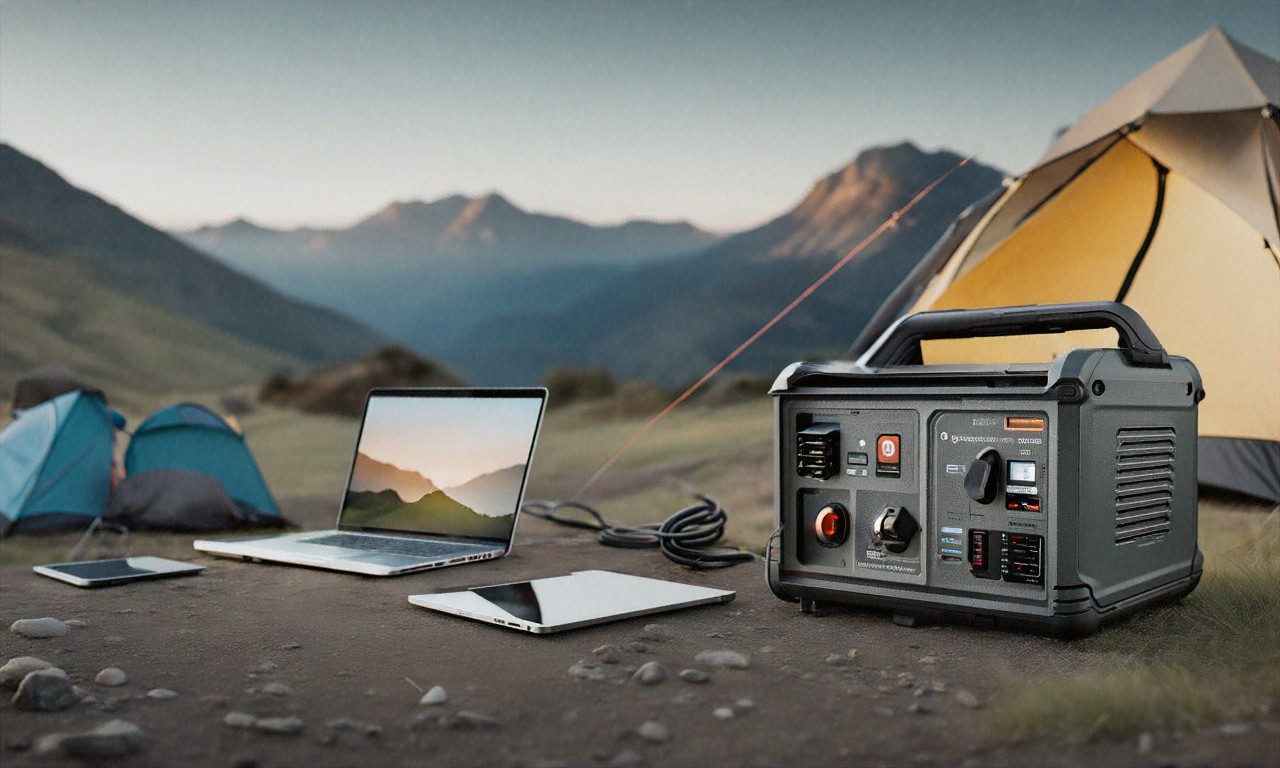
Reviews of the best portable power stations in 2026 for camping, remote work, and emergency backup, covering compact to high-capacity models.
Okay so this is something I’ve been thinking about for a while now, ever since last summer when I dragged two thousand dollars worth of cameras, a drone, a laptop, two phones, a Bluetooth speaker, and a string of LED lights into a state park campsite with zero electrical hookups. Three miles in. No outlets anywhere. About four hours later, staring at a pile of dying gadgets next to a perfectly functional campfire, I had the humbling realization that I’d planned for everything except power. That trip changed my gear priorities completely, and I’ve since spent hundreds of hours testing portable power stations from every major brand, charging laptops, running mini-fridges, powering CPAP machines, even cooking on a small electric griddle off one. So here’s what I’ve learned, and more importantly, what’s actually worth buying right now in 2026.
The basic idea behind these things is simpler than you’d expect. You’ve got a big lithium battery with a built-in inverter, a charge controller, and a bunch of output ports all stuffed into one box. Charge it at home from a wall outlet, a car charger, or solar panels, and then you’ve got portable AC and DC power wherever you go. No fuel. No fumes. No engine noise. Just press a button. That’s probably the single biggest advantage over gas generators, and I think it’s why the market has exploded the way it has. Modern units almost all run LiFePO4 (lithium iron phosphate) chemistry, which gives you excellent cycle life and much better thermal stability than the older NMC cells. Capacity gets measured in watt-hours, so a 1,000Wh unit can theoretically push 1,000 watts for one hour or 100 watts for ten hours. You lose maybe 10-15% to inverter inefficiency in practice, but that math gets you close enough for planning.
EcoFlow and their obsession with charging speed is where I want to start because, honestly, it’s the thing that surprised me most when I first got into this space. Their X-Stream charging technology borders on absurd. The EcoFlow DELTA 2 Max, one of their flagship units, packs 2,048Wh of capacity and charges from 0 to 80% in 43 minutes off a regular wall outlet. Forty-three minutes. That’s over 1,600 watt-hours crammed into a battery in under an hour, while most competing brands need four to six hours for the same thing. I remember plugging it in before a last-minute trip, thinking I’d barely get it halfway, and watching the percentage climb like a stopwatch running backward. Output sits at 2,400 watts continuous with surge capacity hitting 4,800 watts through their X-Boost tech. I ran a full-size blender, a laptop, and a string of work lights off it simultaneously, and the unit didn’t flinch, not even during the blender’s startup spike, which is exactly where cheaper stations trip their overload protection.
For lighter needs, the EcoFlow RIVER 2 Pro gives you 768Wh in a package that weighs about 17 pounds. Charges fully in roughly 70 minutes from the wall. Puts out 800 watts continuous. I’ve taken it on weekend camping trips running a phone, camera, laptop, and some lights, and it’ll handle two full days easily at that kind of load. Top it off with a solar panel during the day and you barely dent the capacity. One thing EcoFlow does better than most is software, too. Their app shows real-time power consumption, remaining runtime, and charging status. You can set custom charge limits to preserve the battery long-term, schedule charging during off-peak electricity hours, and push firmware updates. Sounds minor until you’re rationing power off-grid and you glance at your phone to see exactly how many hours you’ve got left at your current draw. That’s wildly useful information.
Jackery takes a different approach entirely. They were one of the first brands to bring portable power stations to regular consumers, and they’ve stayed relevant by focusing on reliability and simplicity rather than headline-grabbing specs. Their stuff doesn’t charge the fastest. It doesn’t have the flashiest features. But it works, consistently, and the build quality suggests it’ll keep working for years. The Jackery Explorer 2000 Plus is their current heavy hitter: 2,042Wh of LiFePO4 capacity, 3,000-watt output, and here’s the interesting part, it’s expandable. You can bolt on extra battery packs to push total capacity to 12,000Wh. Each expansion adds another 2,042Wh via a simple cable connection. That’s enough to power a small cabin for a day or two, which seems like overkill until you actually need it.
Wall charging takes about two hours, not as fast as EcoFlow but perfectly reasonable for most situations. Where Jackery really pulls ahead is solar. Their SolarSaga panels are well-designed, efficient, and the Explorer 2000 Plus accepts up to 1,400 watts of solar input. With six 200-watt panels in good sunlight? Fully charged in under two hours from solar alone. That’s genuinely off-grid capable, not just marketing speak. I tested it running a portable air conditioner drawing about 500 watts, and the Explorer 2000 Plus lasted just over three hours before hitting 10% battery. Close to the theoretical maximum, which tells you the inverter overhead is minimal. And the build quality, the latches, handles, ports, everything felt sturdy and well-engineered. Like it could survive years of getting tossed in and out of trucks.
If you’re planning a solar-first setup, Jackery probably deserves the top spot on your list. Their panels fold flat for transport, set up in minutes, and connect with Anderson connectors. The built-in MPPT charge controller handles partial shading reasonably well, which matters more than you’d think since a single shadow across one cell can tank the output of a whole panel. I ran an entire weekend campsite off Jackery solar last fall, charging during the day and drawing power at night, and it worked without a hitch. You do need to plan your energy budget, but that’s true of any off-grid arrangement.
Bluetti flies under the radar and I’m not sure why. They’ve consistently offered some of the best value and highest capacity options you can buy, but they don’t seem to get the same buzz as EcoFlow or Jackery. Maybe it’s marketing. Maybe it’s brand recognition. Either way, if you need a lot of stored energy without spending a fortune, they should be on your shortlist. The Bluetti AC200MAX ships with 2,048Wh of base capacity, expandable to 8,192Wh with two B300 expansion batteries. Output hits 2,200 watts continuous, 4,800 watts surge. And the LiFePO4 battery is rated for 3,500+ cycles to 80% capacity. Do the math on that: one full cycle per day, and you’re looking at nearly ten years before the battery degrades in any meaningful way. That longevity completely reframes how you think about the purchase price.
Charging speed is where the AC200MAX is a bit more pedestrian, I’ll be honest. Full charge from the wall takes about three and a half hours, and solar input maxes out at 900 watts. Not bad numbers, just not class-leading. Bluetti’s engineering trade-off has been to invest in capacity and cycle life over charging speed, and depending on your priorities, that might be exactly the right call. For home backup, they also make the EP500 Pro, which is a 5,100Wh monster on wheels that can integrate with your home’s electrical panel as an emergency power source. At 3,000 watts continuous, it runs your fridge, some lights, your internet router, and a few phone chargers for twelve to fourteen hours. That’s enough to ride out most outages without a noisy gas generator producing carbon monoxide next to your house.
One Bluetti trick I appreciate across several of their models is dual-input charging: AC and solar at the same time. If you’re home and the sun is out, plug into the wall and connect your panels simultaneously. The AC200MAX supports up to 1,400 watts of combined input this way, which gets that massive battery topped off in a reasonable timeframe. Small feature. Thoughtful design.
Real-world numbers versus marketing specs is a subject I could probably talk about for hours, but here’s the condensed version from my actual testing. A modern laptop draws about 60-80 watts under active use. From a 2,000Wh station, that gives you roughly 20-25 hours of runtime after inverter losses. I got about 22 hours from the EcoFlow DELTA 2 Max running my M2 MacBook Pro with screen brightness at 50%. Smartphones charge at 15-25 watts, and a full charge eats roughly 20-30Wh from the station, so a 2,000Wh unit can charge your phone from zero approximately 60-70 times. You could take a four-person family on a week-long camping trip, charge everyone’s phone twice daily, and still have headroom.
Portable mini-fridges are trickier because the compressor cycles on and off. Typical draw is 40-60 watts when running, but average consumption settles around 25-35 watts. At that rate, a 2,000Wh station keeps your drinks cold for about 50-60 hours. I tested this with the Jackery Explorer 2000 Plus and a Dometic portable fridge and got 54 hours before the low-voltage cutoff kicked in. Two and a half days. Easily covers a long weekend. CPAP machines, which are a big deal for a lot of people, typically draw 30-60 watts depending on model and pressure settings. Turn off heated humidification and most CPAPs run three to four nights on a single charge from a 1,000Wh unit. That’s enormous for anyone who needs CPAP therapy and also likes camping, or who worries about nighttime power outages.
Battery chemistry matters more than most people realize, and it’s worth a minute on why the industry has shifted almost entirely to LiFePO4. Older and cheaper stations used lithium NMC (nickel manganese cobalt) cells. They’re lighter for the same capacity, which is nice, but the downsides are steep. NMC gives you maybe 500-800 cycles to 80% capacity. LiFePO4 gives you 2,500-3,500. That’s not a small difference; it’s the difference between a product that degrades noticeably after two years versus one that lasts a decade. Safety is the other big factor. LiFePO4 is far more thermally stable. The cells are much less likely to experience thermal runaway, which is the chain reaction that causes lithium batteries to catch fire in worst-case scenarios. For something you’re keeping in your house or your tent, that safety margin seems pretty important to me. The weight penalty for LiFePO4 over NMC has shrunk to maybe 15-25% heavier for equivalent capacity, and given what you gain in lifespan and safety, every major manufacturer has made the switch. I’d avoid any new power station still using NMC at this point.
Adding solar panels turns a big battery into a renewable power source, and that’s where things get genuinely exciting for off-grid use. Most modern stations accept solar input through XT60 or Anderson connectors and include built-in MPPT charge controllers. MPPT (maximum power point tracking) constantly adjusts the electrical load on your panels to extract maximum power even as lighting conditions shift throughout the day. For panel sizing, I’d suggest at least 200 watts of solar for a 1,000Wh station and 400 watts for a 2,000Wh unit. In ideal conditions, full direct sun, clear sky, panels angled right, a 200-watt panel actually produces about 160-180 watts. And you only get peak output for a few hours around solar noon. Realistically, a 200-watt panel generates roughly 600-900Wh per day depending on location and season. That’s enough to replenish a 1,000Wh station in one to two sunny days while also running moderate loads.
All three brands sell their own panels. The Jackery SolarSaga 200 is my favorite for portability since it folds compact and has a built-in kickstand. The EcoFlow 220W is slightly more efficient but heavier. Bluetti’s PV200 is well-made and often priced lower. You can also use third-party panels as long as voltage and connector type match your station’s specs.
Why gas generators keep losing ground is a question with a pretty straightforward answer, and it comes down to three things. Noise first. A typical portable gas generator puts out 60-80 decibels, roughly the volume of a vacuum cleaner. Many campgrounds have quiet hours or outright generator bans. A battery power station produces zero noise. Dead silent. For a lot of campers, that alone ends the conversation. Then there’s the fumes issue. Gas generators produce carbon monoxide, odorless and lethal, and must never run indoors or in enclosed spaces. People die from this every year during power outages. A battery station has zero emissions and is perfectly safe inside your home, tent, or vehicle. And maintenance, or rather the lack of it. Gas generators need oil changes, air filter replacements, fuel stabilizer for storage, and they’ve got dozens of moving parts that can fail. A battery station needs essentially nothing. Charge it, store it, grab it when you need it. I left my EcoFlow DELTA sitting in the garage for three months, picked it up for a trip, and it still showed 75% charge.
Home backup turned out to be the use case I didn’t expect to care about. When I first got into portable power stations, camping was the whole motivation. But then we had a storm last winter that knocked out power for eleven hours. I plugged the fridge into the Bluetti AC200MAX, ran the internet router off it, kept the living room lights on, and charged everyone’s phones. We barely noticed the outage. For this kind of backup, capacity is everything. You want at least 2,000Wh. A refrigerator averages about 100-150 watts, a router takes 10-15 watts, LED lighting pulls 10-50 watts depending on how many fixtures, and phone charging is minimal. All together, maybe 200 watts of continuous draw. At that rate, a 2,000Wh station gets you eight to nine hours. Expandable systems like the Jackery Explorer 2000 Plus or the Bluetti AC200MAX with extra batteries can stretch that past a full day.
Some stations can even integrate with your home’s electrical panel through a transfer switch. Bluetti’s EP500 series and EcoFlow’s DELTA Pro both support this. Grid power fails, they kick in automatically, similar to a whole-home generator but silent and fume-free. Installation requires an electrician and adds several hundred dollars, but for people in areas with frequent outages, it might be worth every penny.
So what should you actually buy? After months of testing, here’s how I’d break it down. For weekend camping and light use, the EcoFlow RIVER 2 Pro at 768Wh hits the sweet spot. Portable enough to carry one-handed, charges absurdly fast for last-minute packing, and has enough juice for a two-day trip running phones, cameras, lights, and a small speaker. Street price runs about $450-550. For extended off-grid trips and solar setups, the Jackery Explorer 2000 Plus paired with two SolarSaga 200 panels. Expandable, best-in-class solar integration, confidence-inspiring build quality. Start with the base unit and add batteries later as needs grow. Expect $2,000-2,500 for the station plus panels. For home backup and heavy-duty use, the Bluetti AC200MAX with at least one B300 expansion battery. Combined 4,096Wh handles extended outages comfortably, the LiFePO4 battery lasts a decade of regular use, and the price-to-capacity ratio beats everything else on the market. Budget around $2,500-3,000 for the full setup. For the best all-rounder, the EcoFlow DELTA 2 Max. Fast charging, solid capacity, strong output, excellent app integration. It’s not the cheapest or the highest capacity, but it does everything well. Usually priced around $1,600-2,000.
A few things I wish someone had told me before I started buying. Pay attention to continuous wattage, not surge wattage. Your station needs to handle the sustained draw, not just the momentary startup spike. Want to run a 1,500-watt appliance? You need 1,500 watts continuous. Period. Don’t drain to zero regularly either. LiFePO4 batteries last longest when cycled between about 20% and 80%. Most modern stations let you set charge limits through their apps, and I’d recommend configuring that if you use yours frequently. Temperature affects performance more than you’d think. Below about 32 degrees Fahrenheit, capacity drops and charging efficiency tanks. Keep the station inside your tent or vehicle in cold weather. Above 100 degrees, avoid charging entirely since heat can damage the cells. And weight, don’t forget about weight. A 2,000Wh station typically weighs 50-60 pounds. Fine for car camping or home backup. Not something you’re hiking with. If portability matters most, look at the 500-1,000Wh class at 15-25 pounds.
Competition between EcoFlow, Jackery, and Bluetti has been fantastic for buyers. Prices have dropped. Capacity has climbed. Charging speeds have improved across the board. Battery chemistry has shifted to safer, longer-lasting LiFePO4 cells. What cost three thousand dollars two years ago now costs half that and performs better in every measurable way. The best station for you is the one that matches your actual usage pattern. Don’t overbuy capacity you’ll never touch, and don’t underbuy only to find yourself rationing power on day two of a five-day trip. Add up your devices’ consumption, give yourself a 30% buffer, and pick accordingly.
I’ll leave you with this. A buddy of mine, total skeptic about portable power stations, borrowed my Jackery for a family reunion at a lakeside cabin that turned out to have one working outlet for twelve people. By Saturday afternoon, he’d become the most popular person there, running a blender for margaritas, keeping a portable speaker going, charging every kid’s tablet, and powering a projector for a movie night on a bedsheet hung between two trees. He texted me a photo of the setup around midnight, everyone sprawled on blankets watching some Pixar film under the stars, the Jackery quietly humming away in the corner with 40% still left. His message said three words: “I get it.” He ordered his own unit the next morning before they’d even packed up the campsite.



(0) Comments