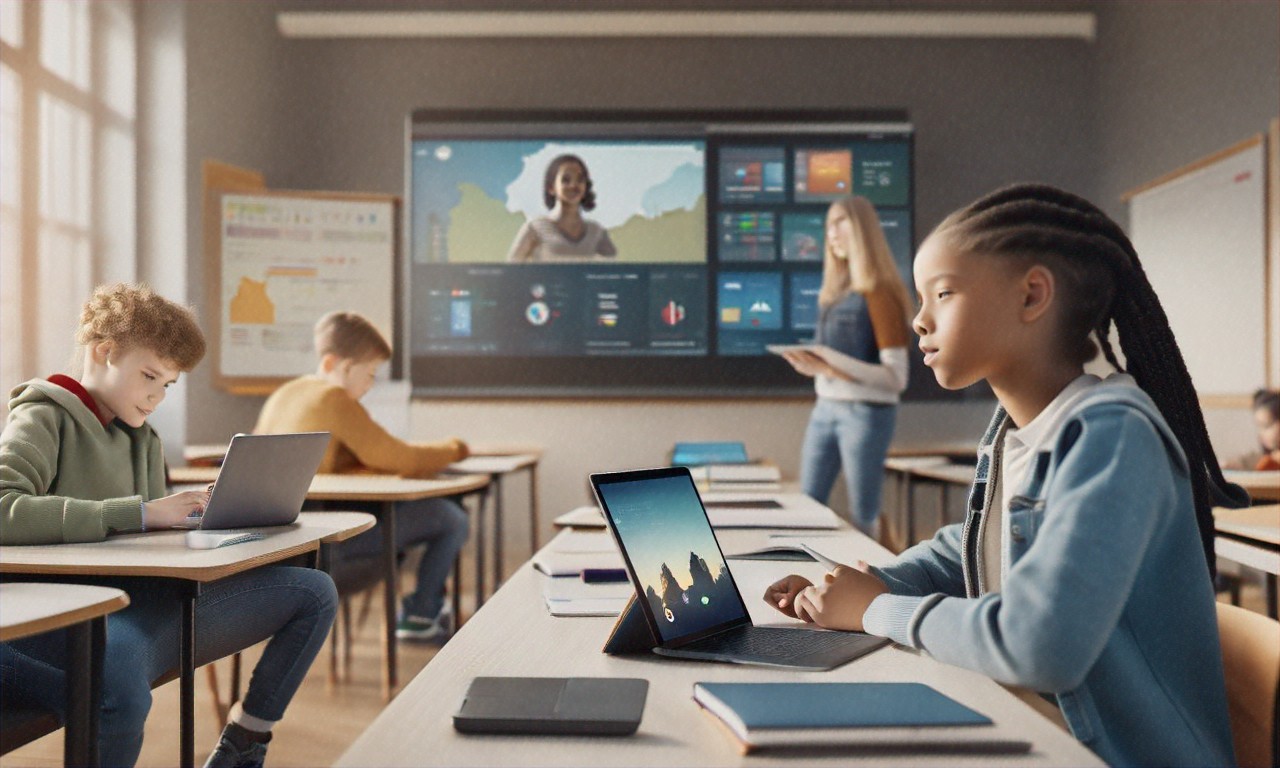
Discover how AI-powered personalized learning platforms are transforming classrooms and improving student outcomes in 2026.
So I was looking at this the other day, a nine-year-old kid in Austin, Texas, sitting at a desk with a tablet, working on fractions. His name was Marcus. His teacher, Mrs. Delgado, had told me he’d been stuck on fractions for weeks. But the software on his tablet had picked up on something specific: Marcus could divide shapes into equal parts just fine. His actual hang-up was the notation, the written part. The app had quietly changed its approach, showing fractions as labels for visual things he already understood. Twenty minutes later he was solving problems that had tripped him up for a month straight. Mrs. Delgado said something that stuck with me. “I’ve got 28 kids. I can’t do that for each one.” And that’s pretty much the whole argument for AI in classrooms, right there in one sentence.
I’ve been writing about technology for about fifteen years now. Sat through more edtech sales pitches than I’d care to remember. Most of them don’t hold up. But something different seems to be happening recently, and it isn’t just better marketing this time around. The actual technology behind adaptive learning has gotten to a point where it can do things that were basically science fiction five years back. Numbers are starting to confirm it too.
What follows is the story of where all this stands right now, the parts that work, the parts that don’t, and the stuff nobody’s really figured out yet.
What Adaptive Learning Actually Looks Like Day to Day
“Personalized learning” gets tossed around so much it barely means anything anymore. So let me be concrete. When Khan Academy or Century Tech or Squirrel AI talk about personalizing education, they’re describing software that watches how a student interacts with material and changes things in real time. Not just serving up an easier question when you get one wrong: that’s been around since the ’90s. What’s happening now is way more detailed than that.
These systems track how long it takes a student to answer. They track hesitation patterns. They look at the sequence of wrong answers, because that tells you the type of misunderstanding, not just that there is one. They measure performance at different times of day. Some of them even track how long a kid pauses before starting a problem. All of that gets fed into a model, and the model builds a pretty detailed picture of how that particular student learns.
Here’s a way to think about it. A regular classroom gives every kid the same path through a textbook. An adaptive AI system builds a different path for each one, and that path shifts every single session based on new data. Say a student nailed algebra on Monday but failed a quiz on Wednesday. The system doesn’t just replay the same lesson. It tries to figure out whether the gap is about understanding the concept, about following the steps, or about something else entirely, maybe the kid was just exhausted that day. Then it adjusts.
Carnegie Learning’s MATHia platform is used in more than 3,000 school districts across the country. It processes something like 200 data points per student per hour. Two hundred signals, analyzed continuously, shaping what shows up on screen next. No teacher can do that for 25 or 30 kids at once. That’s not a criticism of teachers. It’s just the reality of the numbers.
Test Scores and What They’re Showing
I’m skeptical of edtech studies by default. Too many of them are paid for by the company selling the product. But independent research has been stacking up, and it’s pointing in a consistent direction. RAND Corporation published a study in 2025 that followed 12,000 students across 47 schools in six states over two full school years. Students who used AI-adaptive math tools scored 23% higher on standardized tests compared to control groups getting traditional instruction.
The breakdown interested me more than the headline number. Biggest gains came from students in the bottom quartile, the ones who were already struggling. Kids at the top improved a little. Kids at the bottom improved a lot.
That matters. One of the oldest problems in education is what happens when a struggling student falls behind: the class keeps moving, and the gap just widens. Teachers know it happens. They can’t stand it. But with one adult and thirty kids, there’s only so much you can do. AI doesn’t have that problem. It’ll rework a concept seventeen different ways without getting frustrated or running out of class time.
Squirrel AI, which operates mostly in China, released data in early 2026 showing students who used their platform for 40 hours across a semester closed learning gaps that would normally take an entire school year to fix through traditional teaching. I visited one of their learning centers in Shanghai back in 2025. What struck me wasn’t really the tech itself. It was how focused the students were. Quiet, intense, working through problems at their own pace. The system was meeting each kid exactly where they were, and you could tell they felt it.
Teachers Aren’t Going Anywhere
Every time I write about AI and education, teachers email me worried they’re about to lose their jobs. So, plainly: that’s not happening. Not now. Probably not in ten years. Maybe not ever. And I don’t say that to make anyone feel better, I say it because I’ve watched these systems up close, and they’re terrible at the things teachers actually do well.
AI can’t tell that a twelve-year-old has been quiet for three days and ask if something’s going on at home. It can’t run a class discussion that gets a room full of teenagers suddenly interested in World War I. It can’t model empathy. It can’t settle disputes between kids or convince a student who hates school to give it another shot. Those are human things, and they’re why teaching is one of the hardest jobs there is.
What AI does well is the repetitive stuff. Grading quizzes. Tracking which kids have mastered which standards. Putting together progress reports. Flagging students who need help before they actually fail. Mrs. Delgado told me she used to spend 12 to 15 hours every week on grading and paperwork. After her school started using a platform from Amira Learning, it dropped to around four hours. She’s using that freed-up time for small-group work, one-on-one conversations with students, and project-based activities. Her words: “I’m finally doing the job I got into teaching to do.”
A 2025 National Education Association survey found that 67% of teachers who’d been using AI tools for at least a semester said they felt less burned out. That’s a big number for a profession dealing with a burnout crisis. The U.S. is short roughly 55,000 teachers as of early 2026, per the Bureau of Labor Statistics. Anything that helps keep the teachers we’ve got seems worth paying attention to.
The Kids Who Get Left Out of the Conversation
Something that bugs me about how edtech usually gets covered, it’s almost always about well-funded schools in wealthy countries. But the places where AI-powered learning could matter most are the ones with the fewest resources. Think rural schools where one teacher handles multiple grade levels. Or classrooms in developing countries with 60 or 70 students. Or refugee camps where kids have had years of schooling disrupted and are all at wildly different levels.
Late in 2025, I spent a week in Kenya visiting schools that were testing Eneza Education’s AI-based learning platform. It runs on basic feature phones through SMS and USSD. No tablets needed. No broadband. A student texts the system, it texts back a lesson or quiz question, and the AI adapts based on responses. By Silicon Valley standards, it’s rough around the edges. But it’s reaching over 7 million students across sub-Saharan Africa who otherwise wouldn’t get any kind of personalized instruction.
Outside Nairobi, I met a 13-year-old girl named Aisha who’d been on the platform for six months. When she started, she was two grade levels behind in math. By the time I visited, she was performing at grade level. She was also tutoring her younger brother on the same phone. Stories like hers don’t show up on TechCrunch. But they probably represent the most meaningful use of this technology. And honestly, they’re why I haven’t given up on edtech despite all the hype and broken promises I’ve seen over the years.
Nobody’s Solved the Privacy Problem
I can’t write about AI in education honestly without getting into the data privacy issue. These systems work by collecting huge amounts of information about children. How they learn. When they struggle. How long they can focus. What time of day they perform best. In some cases, their emotional state, inferred from facial expressions or typing patterns. That data is worth a lot, and not only for education.
In 2025, the FTC fined two edtech companies a combined $4.2 million for sharing student data with advertisers without parental consent. Both claimed the data was anonymized. An independent audit found it wasn’t. This isn’t some theoretical concern. It’s already happening.
COPPA, the Children’s Online Privacy Protection Act, dates back to 1998 and hasn’t been updated in any serious way since. It’s not up to the task for the AI era. The EU’s GDPR is better, but even it struggles to keep pace with how fast these systems change. And in a lot of countries, there’s basically no legal framework at all covering how AI platforms collect student data.
I’m not arguing we should stop using these tools over privacy worries. I’m saying we need actual guardrails, and we need them before the data collection gets so baked in that there’s no walking it back. School districts need people whose job is data privacy. Vendors should have to submit to independent audits. Parents need to understand what they’re agreeing to when they sign those permission forms that, let’s be real, nobody reads. The technology is moving fast. Policy is moving at the speed of a congressional subcommittee: which is barely at all.
Bias Built Into the System
There’s another issue that doesn’t get talked about enough but probably should. Adaptive learning systems get trained on historical data. And historical data carries historical inequities. If a model was trained mainly on data from well-resourced schools where students had tutors, enrichment programs, and stable home lives, it might develop assumptions about how learning works that just don’t apply to kids from different backgrounds.
MIT’s Media Lab published a study in 2025 that looked at three popular adaptive learning platforms. They found measurable performance gaps along racial and socioeconomic lines, not because the students were different by nature, but because the systems had been built using datasets that underrepresented those groups. The platforms were less accurate at spotting learning gaps for Black and Latino students and for kids from low-income families. None of this was intentional. It was baked-in bias, which in some ways is harder to deal with because it’s harder to even notice.
A few companies are trying to address it. Khan Academy has been working with Stanford researchers to diversify the training data for Khanmigo, their AI tutoring tool, and testing for demographic gaps. Century Tech in the UK publishes annual bias audit results. But these are outliers. Most edtech vendors don’t test for bias at all. Most school administrators don’t even know they should be asking about it.
What Separates Schools That Get It Right
I’ve been in schools where AI tools are working great and schools where the software is just sitting there unused. The technology itself is almost never the difference. It’s how the school introduced it. The pattern I keep seeing is straightforward: schools that succeed treat AI as something that adds to good teaching, not something that stands in for it. They put money into training. They give teachers time to learn the tools before students ever touch them. They start small, one subject, maybe, or one grade level) and grow based on what the data shows.
Singapore’s Ministry of Education is maybe the best example going right now. In 2024, they rolled out a national adaptive learning program across all public secondary schools, but they’d spent two full years preparing teachers first. Every educator got 80 hours of professional development focused on working with AI tools in the classroom. They didn’t just learn the software. They learned how to read the data it produced, how to tell when the AI was making bad suggestions, and how to override it when their own judgment said differently. Results so far: a 19% bump in math scores, 14% in science, with the biggest gains among students who’d been struggling before.
Compare that to a large school district in Florida (I won’t say which one, that bought a $3 million adaptive platform in 2024, pushed it out in September with barely any teacher training, and quietly pulled it by January because nobody was using it. Teachers hadn’t been asked. They didn’t understand the system. They resented having it dropped on them. Three million dollars, gone. And from what I’ve seen, this kind of thing happens more than the industry likes to admit.
What’s Happening in Colleges
K-12 gets most of the attention, but AI-driven personalization is making real headway in higher education too. Arizona State University has been out front on this, partnering with CogBooks since 2018 on adaptive intro courses. Their numbers show students in AI-adaptive sections are 18% more likely to earn a C or better compared to traditional lecture sections. Dropout rates in those courses have fallen by a third.
Georgia Tech built an AI teaching assistant years ago, it started as “Jill Watson” back in 2016, and it’s grown into a system that now handles about 40% of student questions in large online courses without a human stepping in. Students often can’t tell whether they’re chatting with the AI or a real TA. And it’s available around the clock, which matters a lot for working adults and students in other time zones who can’t show up to office hours.
Community colleges might have the most to gain here, I think. They serve a disproportionate share of first-generation and low-income students. Amarillo College in Texas saw a 12-point jump in course completion rates after rolling out Realizeit’s adaptive platform in developmental math. Developmental math is the gatekeeper course, the one that blocks more community college students than any other. Twelve points is a big deal. For the students it affects, it could be the difference between staying enrolled and dropping out.
Where Things Seem to Be Heading
I don’t have a crystal ball. But trend lines are trend lines. The cost of AI learning tools is dropping. Google’s LearnLM, announced late 2025, is bringing adaptive tutoring into Google Classroom for free, and Google Classroom is used by more than 150 million students worldwide. OpenAI is working with several state education departments on tutoring models trained to specific state curricula. Apple’s education team is reportedly building something for the iPad, though they haven’t confirmed details yet.
Within three to five years, I’d guess some version of AI-adaptive instruction will be standard in most schools in developed countries. Like interactive whiteboards became in the 2010s, just part of the furniture. The question isn’t really whether adoption happens. It’s whether it happens well. And that depends on choices being made right now by school boards, policymakers, and the companies building these tools.
But I keep thinking about Marcus. That kid in Austin, sitting with his tablet, working through fractions with a confidence he didn’t have a month before. And Mrs. Delgado watching him, looking relieved, because for once the technology was actually helping a kid who needed it instead of just measuring how far behind he was. That’s what this stuff should be for. Not replacing teachers. Not collecting data. Not pumping up some company’s valuation. Just helping kids learn the way that works for them.
If that simple idea stays at the center of all this, the planning, the spending, the policy debates) we might actually get it right. I’m cautiously optimistic about it. Which, if you know me, is about as fired up as I get.


Great article! I have been following the developments in generative AI closely and the healthcare applications are particularly exciting. The ability to simulate clinical trials could save years of research time.
As a software developer, I can confirm that AI coding assistants have significantly improved my productivity. However, I still think human oversight is crucial for maintaining code quality.